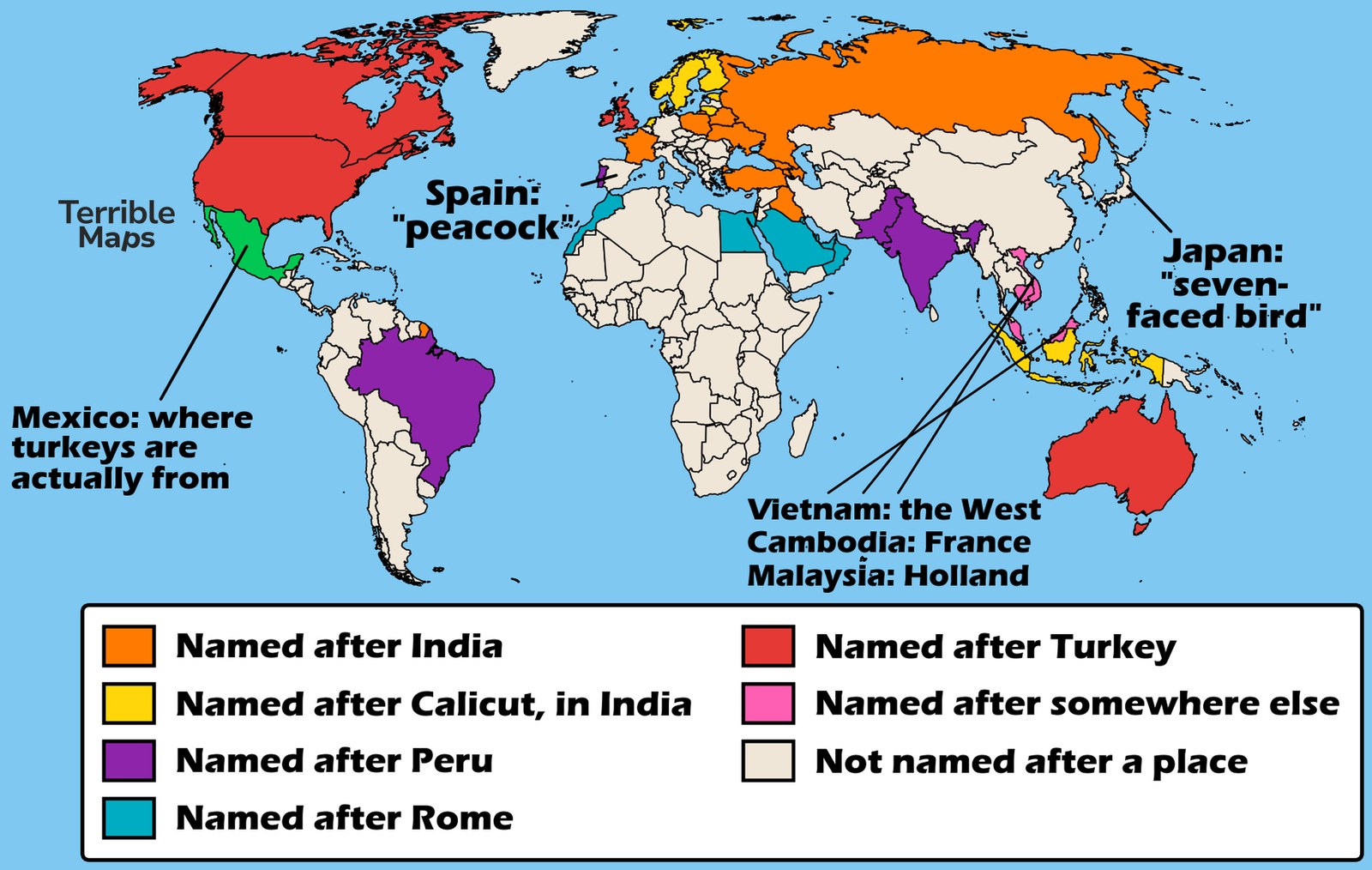
In English the bird is probably named after the country, but not because it comes from there. The word first meant the guinea fowl, an African bird that reached Europe through Turkish traders, and it moved over to the American bird when that arrived in the 1500s. Sources don’t fully agree on the details.
Turkey thinks it’s from India
In Turkish the bird is a hindi, from an old word for Indian. French has dinde, from poule d’Inde, the hen of India, and the Polish, Russian, Hebrew and Georgian names point to India too. Europeans called the Americas the Indies, and the mix-up stuck. The Dutch went more specific with kalkoen, after Calicut, a port in India, and the Scandinavians, the Finns and Indonesia followed them.
And India thinks it’s from Peru
Portuguese calls it peru, after the country. The Hindi word, pīrū, most likely comes from the Portuguese, so India is probably naming it after Peru. Arabic speakers in Egypt and the Gulf call it the Roman rooster, Malaysia has the Dutch chicken, Cambodia the French chicken and Vietnam the Western chicken.
Spanish calls it pavo, from the old Latin word for peacock, and Japan calls it the seven-faced bird, after the skin on its neck that changes colour. Mexico’s word, guajolote, comes from the Nahuatl huehxolotl, from the people who were there first.
So in English it’s named after Turkey, in Turkey it’s named after India, and in India it’s named after Peru. It isn’t from any of them.
 The bookTerrible Maps: Hilarious Maps for a Ridiculous WorldOut now in the UK, US, Canada and Australia.
 The shopShirts, hoodies, mugs and printsIncluding the Africa / Asia T-shirt.