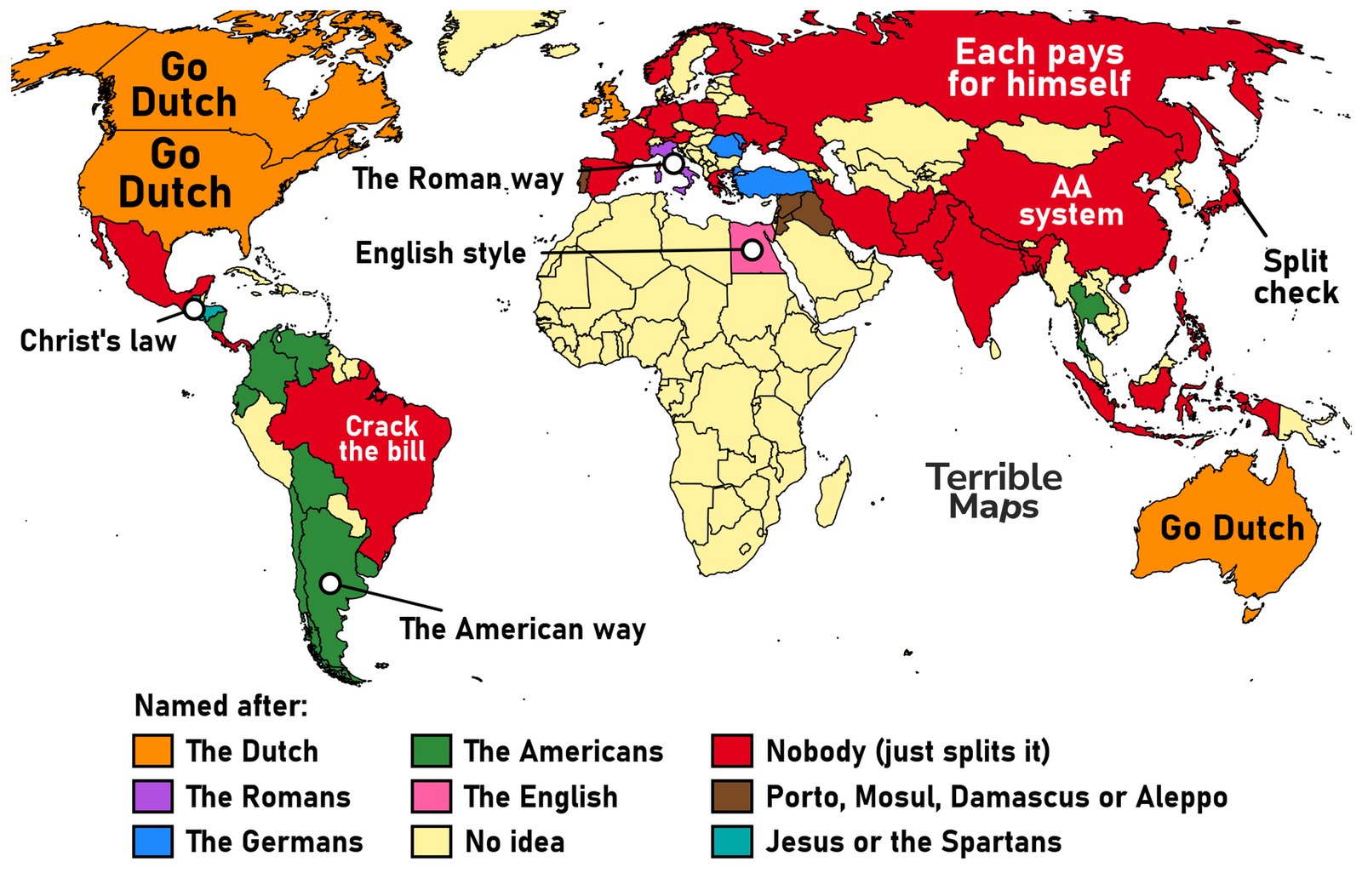
Going Dutch belongs to a whole family of rude English phrases about the Dutch, Dutch courage included, and the Oxford English Dictionary puts that family down to rivalry between England and the Netherlands in the 17th century. The bill-splitting one came much later. The earliest written “Dutch treat” that the word historian behind Wordorigins could find is American, from 1870.
It may not even have been about the Dutch. Four years later an American travel book used “the Dutch treat” for the way Germans drank lager, with each man paying for what he had, and in America “Dutch” was often used for Germans.
South Korea borrowed the idea as deochipei, Dutch pay, which is built from English words but isn’t something English speakers say. The Dutch themselves just say apart betalen, pay separately, so after more than 150 years of having it named after them, they don’t name it after anyone.
Romans, Germans and Americans
Italians pay alla romana, the Roman way, which means dividing the total by the number of people at the table rather than everyone paying for what they ordered. In Turkey it’s Alman usulü, the German method, and in Romania and Moldova you pay the German way. Thailand calls it American share.
Much of Spanish-speaking Latin America calls it pagar a la americana, paying the American way. The Diccionario de americanismos, the Spanish academies’ dictionary of Latin American Spanish, records it in Nicaragua, Colombia, Venezuela, Bolivia, Chile, Argentina and Uruguay, and in Ecuador as old-fashioned. So in a fair part of the Americas, paying the American way just means paying for yourself.
Jesus, Sparta and four cities
In Guatemala the saying is a la ley de Cristo, cada quien con su pisto: by Christ’s law, each with his own money. Honduras says como dijo Cristo, as Christ said, although I can’t find where in the Bible he said it. Both work because Cristo rhymes with pisto, which is slang for money. El Salvador uses the same trick with a different authority: ley de Esparta, cada quien paga lo que se harta, or Spartan law, everyone pays for what they eat.
Four more phrases are named after a city. According to Wikipedia, Iraqis call it Maslawiya, Mosul style, and in Syria, Lebanon, Jordan and Palestine it’s named after Damascus or Aleppo. The same article says the people of Mosul and Damascus have a reputation for being careful with money.
Portugal’s version, contas à moda do Porto, Porto-style bills, is meant more kindly. A Portuguese radio site puts it down to the honest bookkeeping of Porto’s merchants, then admits that’s only a legend.
Egypt is the odd one out. Wikipedia says Egyptians call it Englizy, English style, although the only other source I could find lists the phrase without saying where it’s used.
Everyone else
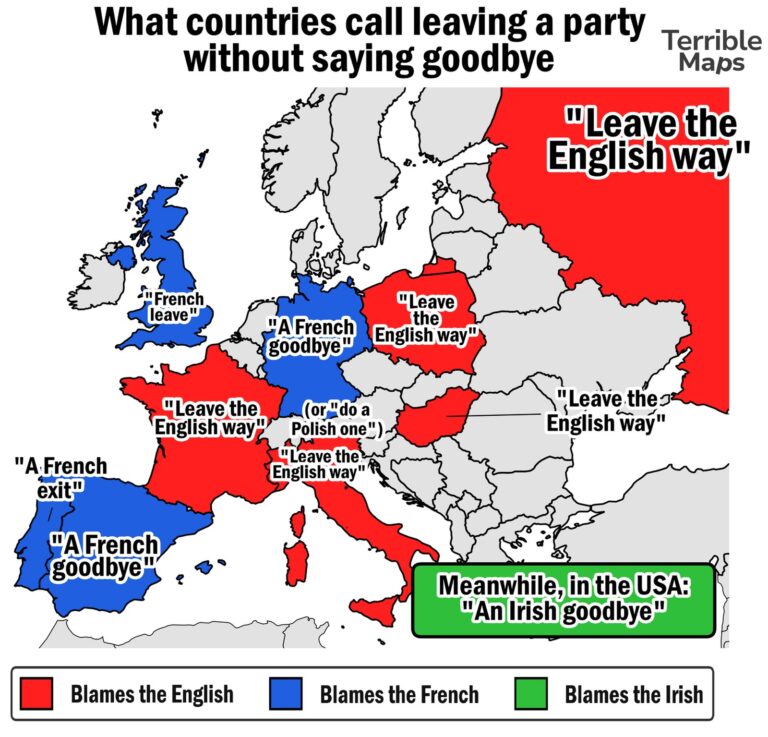
A lot of the world doesn’t name it after anyone, which is the big red area on the map. Japan’s warikan means split check, and China says AA zhi, the AA system, where each A stands for one diner. Greece’s word, refenés, was borrowed from Turkish, so even Greece’s plain version came from a country that names it after the Germans.

 The bookTerrible Maps: Hilarious Maps for a Ridiculous WorldOut now in the UK, US, Canada and Australia.
 The shopShirts, hoodies, mugs and printsIncluding the Africa / Asia T-shirt.