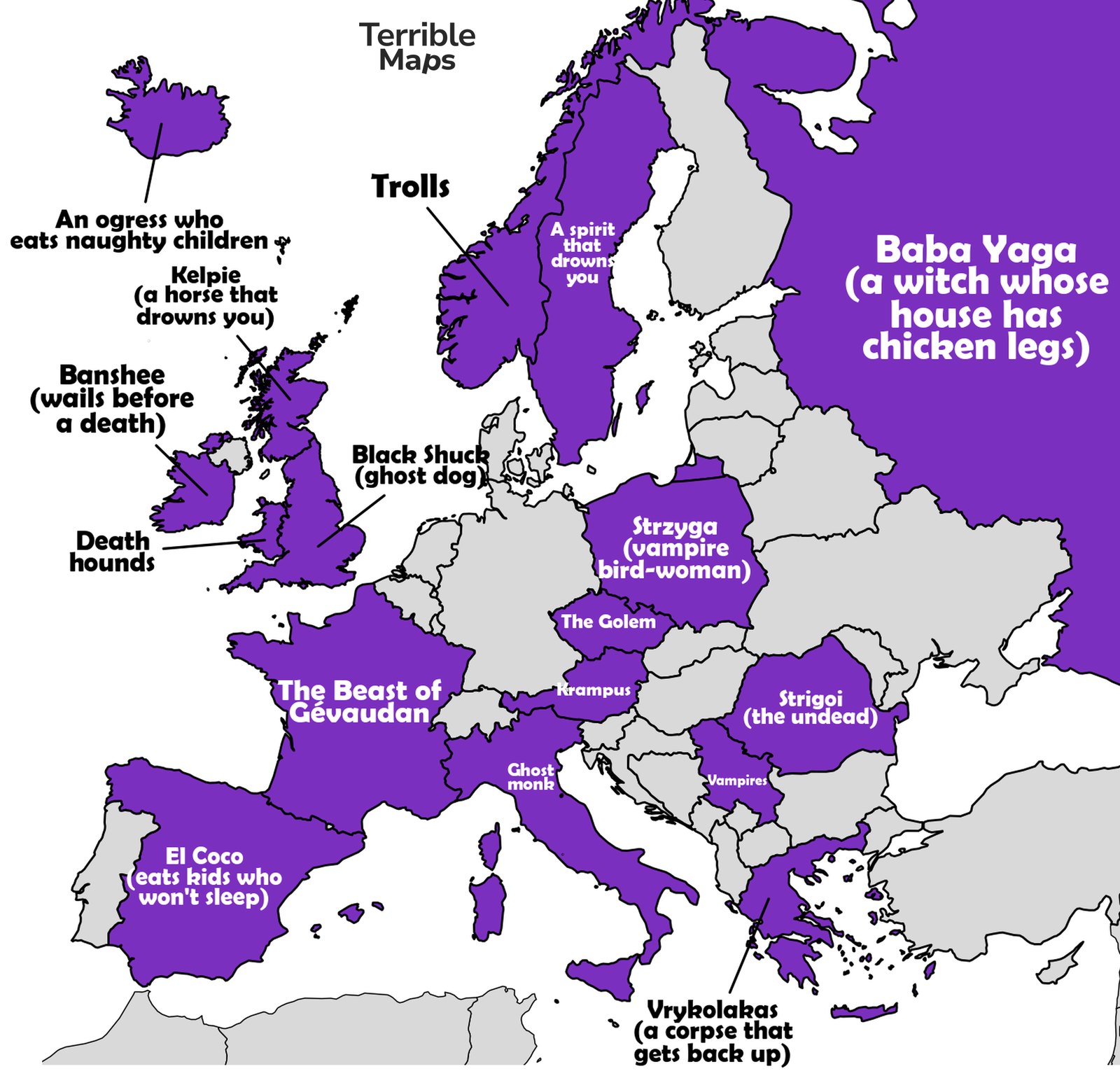
Most of Europe has a monster it’s known for, from a Russian witch whose house stands on chicken legs to an Icelandic ogress who eats naughty children, and this map shows which monster each country is best known for.
The ones that eat children
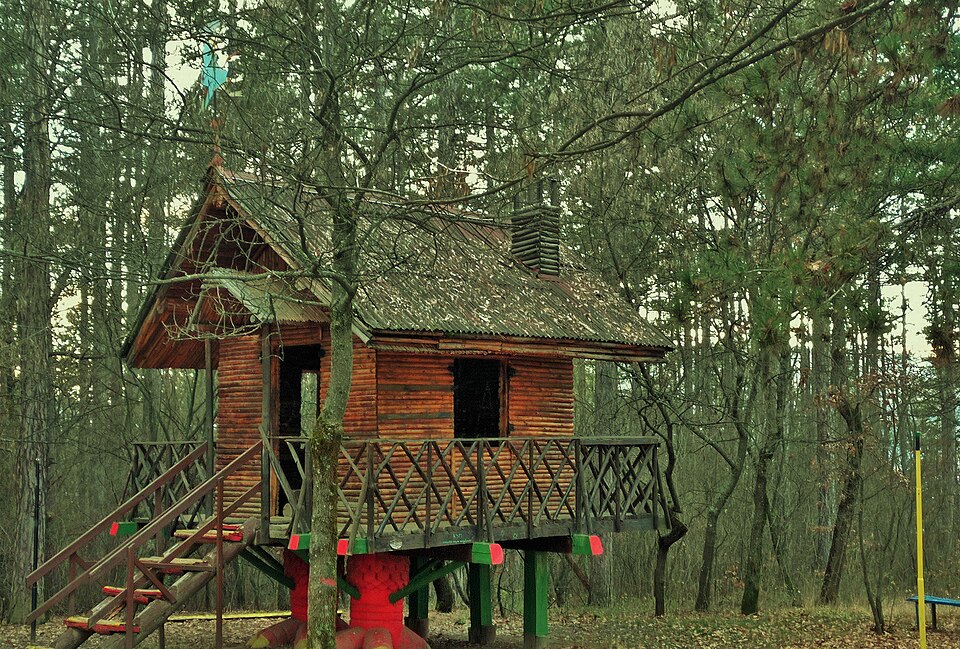
Baba Yaga lives in a hut on chicken legs that turns round, and she flies about in a mortar, steering with a pestle, and in some tales she cooks and eats children while in others she helps the hero, and her first clear mention is in Lomonosov’s Russian Grammar of 1755, which is an unusual place to find a witch. Iceland’s Grýla goes round the farms asking for naughty children, and her pet, the Yule Cat, eats anyone who hasn’t got new clothes before Christmas Eve, a story that was used to get farm workers to finish the autumn wool.
The ones that might have happened
England’s Black Shuck is said to have turned up in a storm on 4 August 1577 at Blythburgh, where the church’s north door still has the scorch marks. France is the exception, because the Beast of Gévaudan was real, an animal blamed for attacks in the south of the country from 1764 until Jean Chastel shot the animal credited with ending it on 19 June 1767.
Krampus, the Golem and a vampire
Krampus, the horned companion of St Nicholas, isn’t recorded before the 16th century, but after several Krampus runs in East Tyrol in 2013, 8 people were admitted to hospital in Lienz, which is more than most monsters on this map can claim. The Golem of Prague is credited to a 16th-century rabbi, although historians trace the story to German writing from 1837, and Serbia’s vampire, Sava Savanović, is said to haunt a watermill near Zarožje, which didn’t stop Valjevo making him its tourist mascot in 2010.
| Country | Monster | What it is |
|---|---|---|
| Russia | Baba Yaga | A witch whose hut stands on chicken legs |
| Iceland | Grýla | An ogress who eats naughty children |
| France | The Beast of Gévaudan | A real animal blamed for attacks, 1764 to 1767 |
| Spain | El Coco | Eats children who won't go to sleep |
| Serbia | Sava Savanović | A vampire said to haunt a watermill |
See all 17 countries
| Austria | Krampus | The horned companion of St Nicholas |
| England | Black Shuck | A black ghost dog |
| Czechia | The Golem | A figure said to be made by a rabbi in Prague |
| Ireland | Banshee | A spirit whose wail warns of a death |
| Scotland | Kelpie | A shape-shifting water horse |
| Wales | Cŵn Annwn | Spectral hounds |
| Norway | Trolls | Giants of the forests and mountains |
| Sweden | Näcken | A water spirit |
| Poland | Strzyga | A vampire-like bird-woman |
| Italy | Monaciello | A little ghost monk of Naples |
| Romania | Strigoi | The restless undead |
| Greece | Vrykolakas | A vampire |
If you like this sort of thing, see the rest of my Halloween maps or which countries think raccoons are very clean bears.
Sources: Wikipedia, Baba Yaga, Grýla, Yule Cat, Black Shuck, Beast of Gévaudan, Krampus, Golem, Sava Savanović, Cucuy.
Share this map
More from Terrible Maps
 The bookTerrible Maps: Hilarious Maps for a Ridiculous WorldOut now in the UK, US, Canada and Australia.
 The shopShirts, hoodies, mugs and printsIncluding the Africa / Asia T-shirt.
There’s a new terrible map most days on Facebook and Instagram.