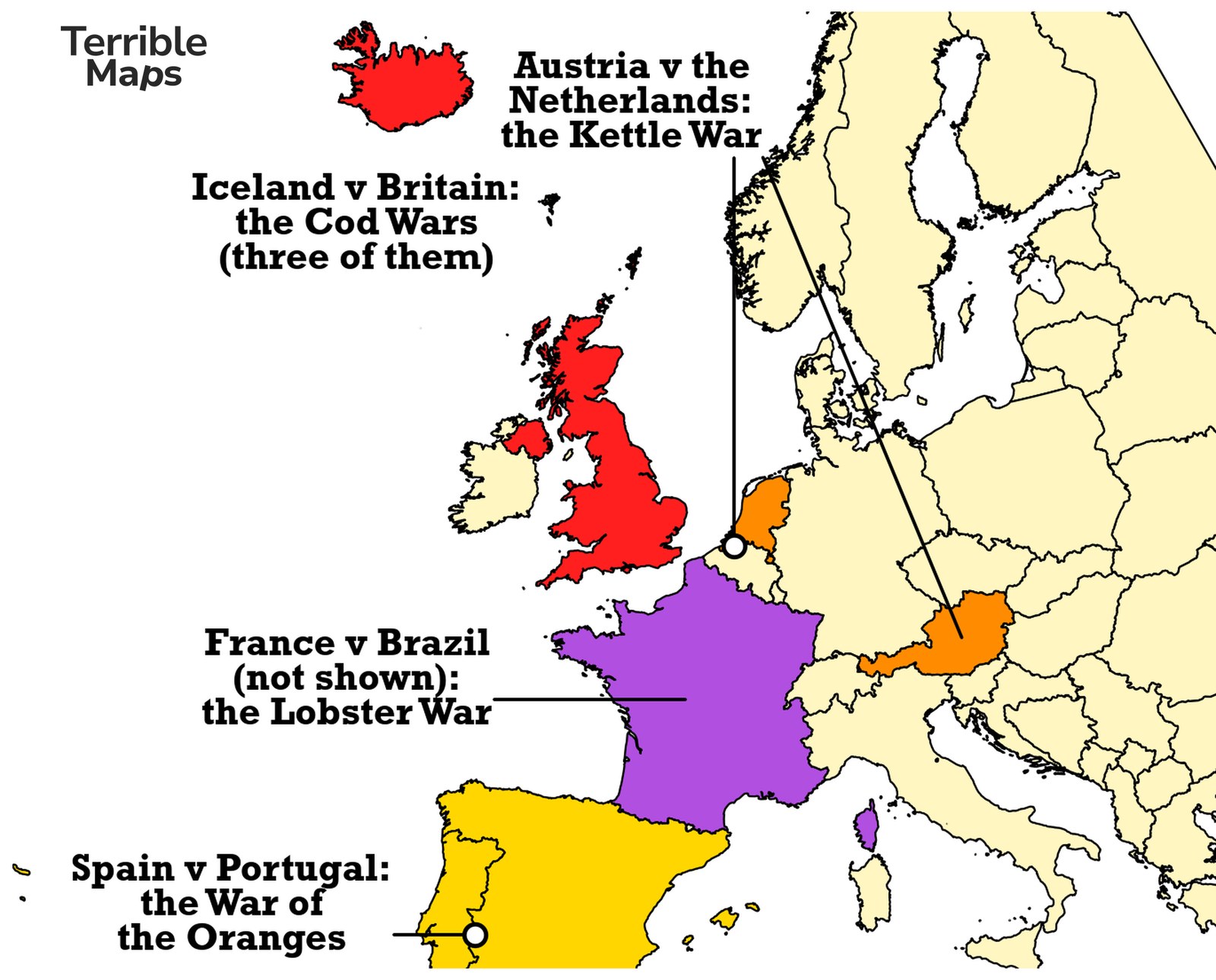
Joseph II, who ruled Austria, also ruled the Austrian Netherlands, which is roughly today’s Belgium. He wanted the River Scheldt opened so that ships could reach the port of Antwerp, but the Dutch had kept it closed to Antwerp’s trade since 1585. Joseph was sure they wouldn’t dare fire on a ship flying his flag, so he sent a merchant brig, Le Louis, down the river to find out.
A Dutch warship, the Dolfijn, stopped Le Louis near Fort Lillo, a fort on the river. The one shot anyone remembers hit a soup kettle, and Le Louis surrendered on the spot. So the Dutch kept their river closed, and then, under a peace treaty the next year, paid Austria to settle the row anyway. Nobody agrees how much: estimates run from 2 million to 10 million guilders.
The Lobster War
In 1961 Brazil told French fishing boats to stop catching spiny lobster about 160 km off its north-east coast. The argument that followed came down to whether a lobster walks or swims. Brazil said lobsters crawl along the seabed, which made them part of Brazil’s continental shelf and so Brazil’s. France said lobsters swim, which made them fish, and fish out at sea belong to whoever catches them.
A Brazilian naval officer mocked the French case: “if a lobster is a fish because it moves by jumping, then a kangaroo is a bird.” France’s president, Charles de Gaulle, sent a destroyer to guard the French boats, and Brazil answered with cruisers, destroyers, a submarine and aircraft. Rio took it less seriously. A wall in the city read “Lobsters yes, De Gaulle no”, and carnival crowds danced a new lobster samba.
The science didn’t settle it: Time magazine reported that Brazil’s own naturalists said some lobsters swim and some don’t. France pulled its warships out in March 1963 without a shot being fired. Under a deal signed the next year, 26 French boats could keep fishing there for five years, as long as a share of the profits went to Brazilian fishermen.
The Cod Wars
Iceland and Britain fought three Cod Wars between 1958 and 1976. Each began when Iceland widened the area of sea where only its own boats could fish: first to 12 nautical miles, then 50, then 200. Each time, British trawlers kept fishing inside it.
Iceland’s coastguard answered with a new weapon: underwater blades, towed behind its patrol ships, that sliced through the trawlers’ nets. Britain sent Royal Navy frigates to protect its trawlers, including two old ones brought back with strengthened bows for ramming, and in the third war alone there were 55 rammings. British sailors also pelted the Icelandic ships with potatoes, eggs and bags of flour.
Iceland won all three, mainly because it threatened to close the NATO base at Keflavík, which had an important US Air Force presence and a listening station. Britain came under pressure from its allies to give way. In June 1976 Britain accepted the 200-mile limit, and that deal has held ever since.
The War of the Oranges
In 1801 Napoleon and Spain’s chief minister, Manuel Godoy, ordered Portugal, the last ally Britain had left on the continent, to break with Britain. Portugal refused, so Spain invaded, with France on its side.
Godoy led the Spanish army himself. When he reached the Portuguese fortress town of Elvas, he is said to have picked oranges outside its walls and sent them to Queen Maria Luisa of Spain, who was rumoured to be his lover. The message with them said he would soon be in Lisbon. That gift of oranges gave the war its name.
He never took Elvas or reached Lisbon, but Spain still won. Within three weeks Portugal signed a treaty giving up Olivenza, a town just across the river from Elvas, and Spain has held it ever since. Portugal has never recognised that, and its military maps still leave the border there undrawn. In 2024 Portugal’s defence minister, Nuno Melo, said Olivenza “is Portuguese”, then said that was only his personal view as the leader of his party.
 The bookTerrible Maps: Hilarious Maps for a Ridiculous WorldOut now in the UK, US, Canada and Australia.
 The shopShirts, hoodies, mugs and printsIncluding the Africa / Asia T-shirt.