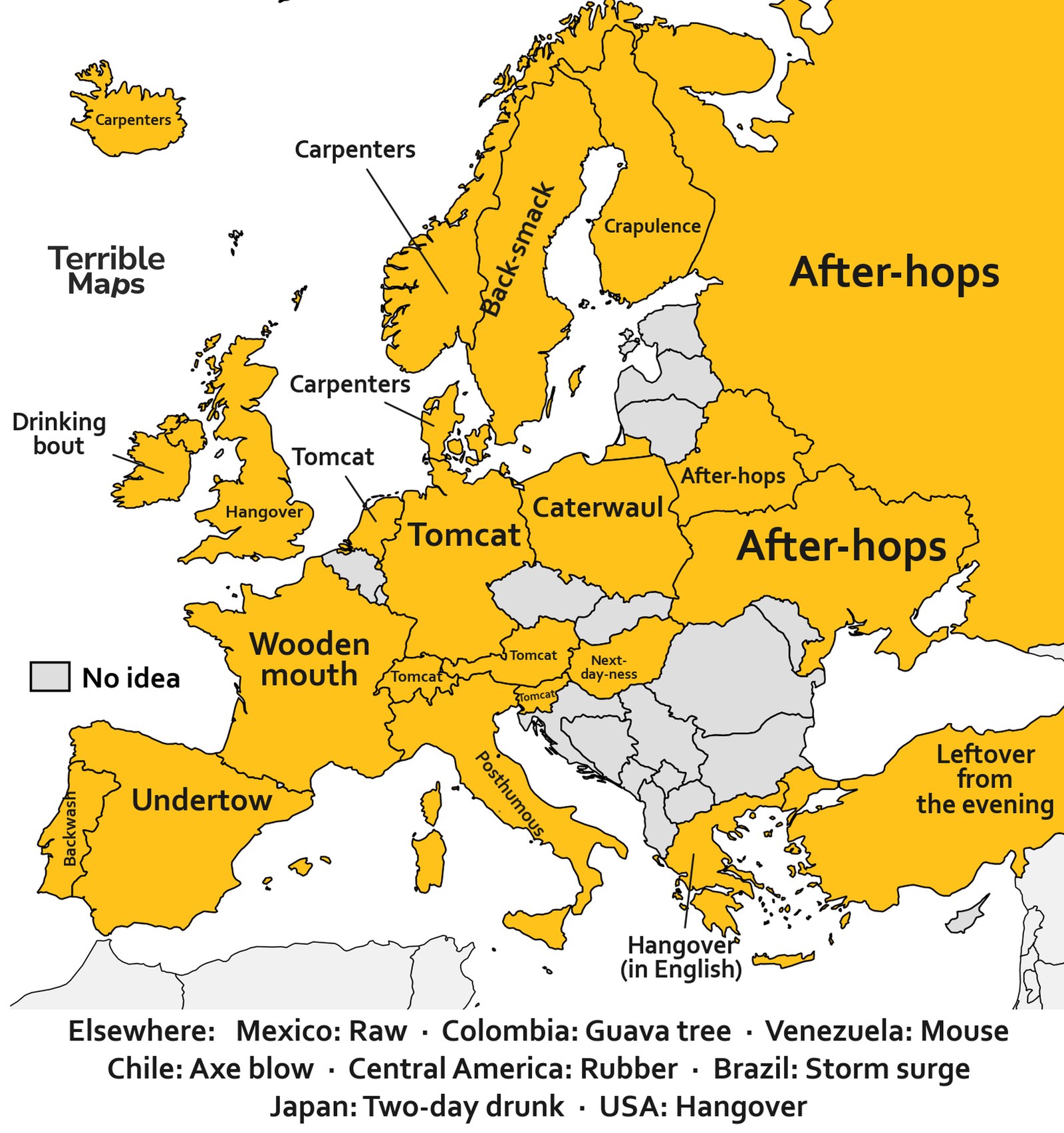
Hangovers are called some strange things around Europe, and six of the countries on this map blame a cat.
More lost in translation maps→
Why do Germans call a hangover a tomcat?
Germans call a hangover Kater, tomcat, probably because of a student joke in the 1800s on Katarrh, the medical word for a heavy cold. Before that, German students called the morning after Katzenjammer, cats’ wailing.
Germany, Austria, Switzerland, the Netherlands and Slovenia all say tomcat now. Poland kept the older cats’ wailing and cut it down to kac, which is why its label says caterwaul.
In the 1950s the Poles tried a home-grown word, kociokwik, cat-squeal. It went out of use, partly because kwik is the noise a pig makes.
The carpenters in Nordic heads
In Denmark, Norway and Iceland a hangover is carpenters, from the idea of little men hammering away inside your head. Sweden says baksmälla, a smack from behind.
What do Greeks call a hangover?
Greeks just use the English word, hangover, because their own ancient word now means the night out itself. Aristotle wrote that a hangover hurts more than being drunk, because the drunk man is witless and the hungover one has his wits back. Finland still uses the ancient Greek word for it, as krapula, which also gave English the word crapulence. So the Greeks had a word for a hangover more than 2,000 years ago, and now they borrow one from English.
The rest of the map
Russia, Ukraine and Belarus wake up with after-hops, from hops, the beer plant, which in Russian also means drunkenness. The French wake up with a wooden mouth.
Spain, Portugal and Brazil name it after the sea, the undertow, the backwash or a storm surge, and none of my sources know why.
Mexicans feel raw, and Chileans can have an axe blow. Central Americans have rubber, the Japanese are two-day drunk, and Venezuelans have a mouse, which nobody can explain.
Colombians say guava tree. Across Spanish America a guava came to mean a lie, because a rotten one can look fine from the outside, and in Colombia it ended up meaning someone who looks well but isn’t.
| Country | What they say | Literally |
|---|---|---|
| Germany, Austria, Switzerland | Kater | Tomcat |
| Netherlands | Kater | Tomcat |
| Slovenia | Maček | Tomcat |
| Poland | Kac | Caterwaul (cats' wailing) |
| Denmark | Tømmermænd | Carpenters |
See all 28 countries
| Norway | Tømmermenn | Carpenters |
| Iceland | Timburmenn | Carpenters |
| Sweden | Baksmälla | Back-smack |
| Finland | Krapula | Crapulence |
| Greece | Hangover | Hangover (in English) |
| Russia | Pokhmelye | After-hops |
| Ukraine | Pokhmillia | After-hops |
| Belarus | Pakhmielle | After-hops |
| France | Gueule de bois | Wooden mouth |
| Hungary | Másnaposság | Next-day-ness |
| Turkey | Akşamdan kalma | Leftover from the evening |
| Ireland | Póit (Irish) | Drinking bout |
| Italy | Postumi | Posthumous |
| Spain | Resaca | Undertow |
| Portugal | Ressaca | Backwash |
| Brazil | Ressaca | Storm surge |
| Mexico | Cruda | Raw |
| Chile | Hachazo | Axe blow |
| Central America | Goma | Rubber |
| Venezuela | Ratón | Mouse |
| Colombia | Guayabo | Guava tree |
| Japan | Futsukayoi | Two-day drunk |
| UK and USA | Hangover | Hangover |
If you like this sort of thing, see who each country blames for leaving a party without saying goodbye or which foreigners each country named the cockroach after.
Sources: Wiktionary (Kater, Katzenjammer, kac, tømmermænd, timburmenn, baksmälla, kopparslagare, krapula, κραιπάλη, hangover, похмелье, gueule de bois, akşamdan kalma, póit, postumus, cruda, hachazo, caña, goma, resaca, postumo, másnapos, 二日酔い, guayabo, ratón); DWDS, Kater; Etymologiebank, kater; National Geographic Polska; SSKJ, maček; NAOB, tømmermann; The Local Denmark; Sententiae Antiquae, kraipale; Priberam, ressaca; Treccani, postumo; El País Cali, guayabo.
 What each country calls a hippo, translated literally
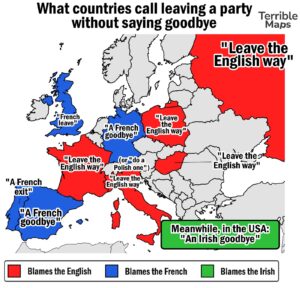 What countries call leaving a party without saying goodbye
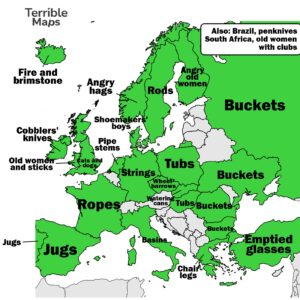 What it rains instead of cats and dogs
Share this map
More from Terrible Maps
 The bookTerrible Maps: Hilarious Maps for a Ridiculous WorldOut now in the UK, US, Canada and Australia.
 The shopShirts, hoodies, mugs and printsIncluding the Africa / Asia T-shirt.
There’s a new terrible map most days on Facebook and Instagram.