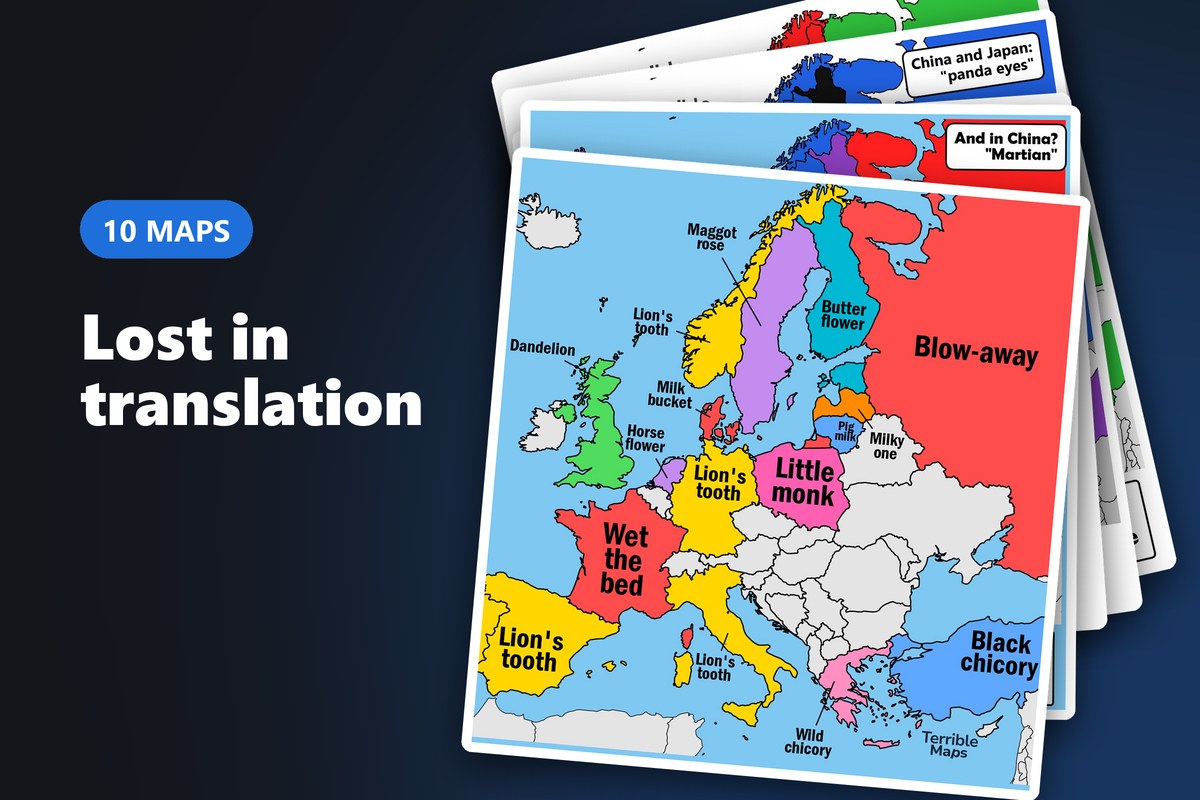
Fifteen maps of what Europe calls things, translated word for word, from dandelions and heavy rain to black eyes, French toast and the Danish pastry, which Denmark names after Vienna.
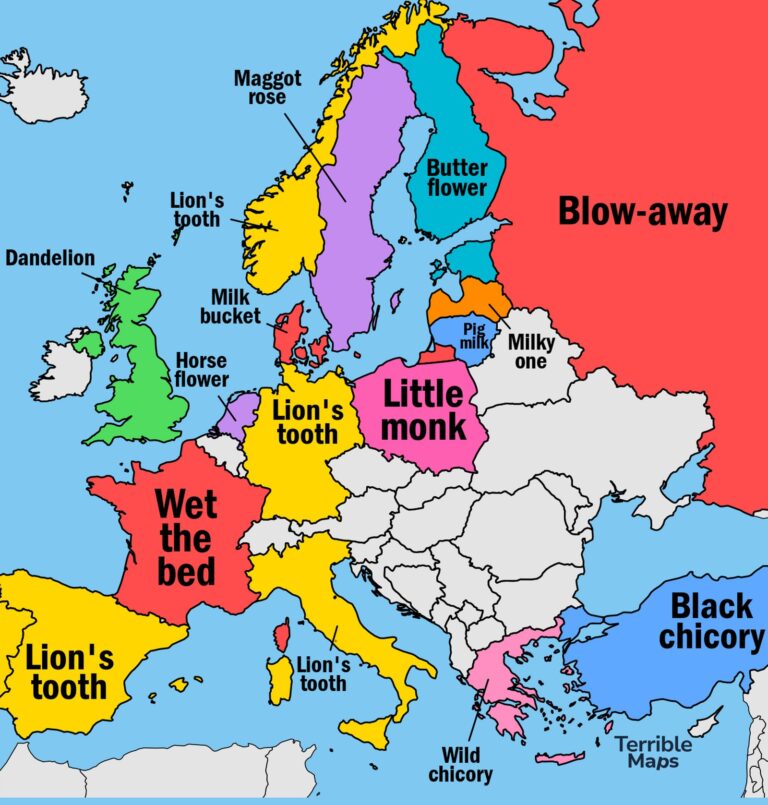
What Europe calls a dandelion, translated
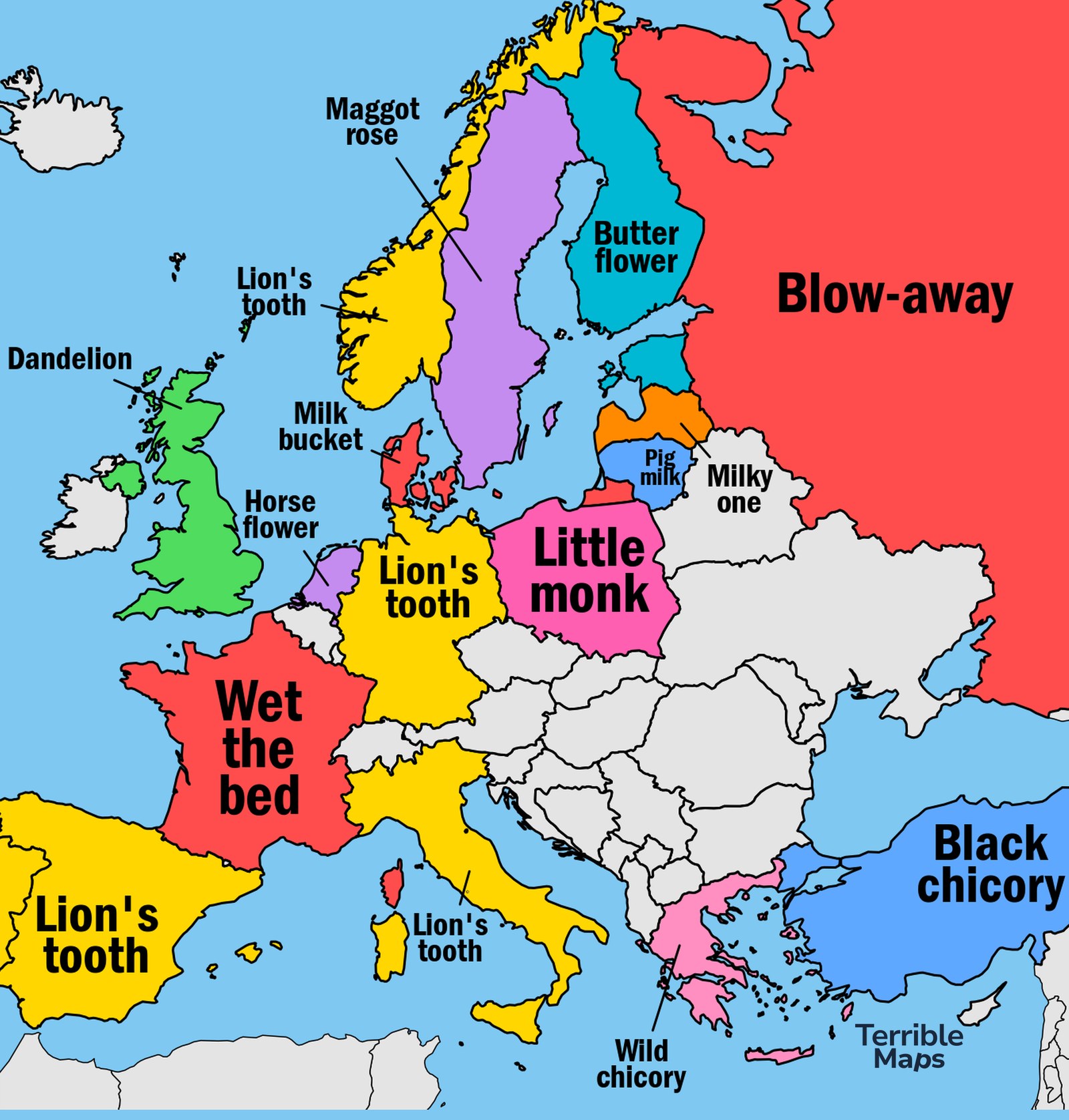
The English name comes from the French dent de lion, a lion’s tooth, and the German Löwenzahn means the same. The French themselves now say pissenlit, from pisse en lit, after the plant’s diuretic effect, and in Polish it’s a little monk.
This map has its own post: What Europe calls a dandelion, translated.
Sources: Wiktionary, dandelion, Löwenzahn, pissenlit, mniszek.
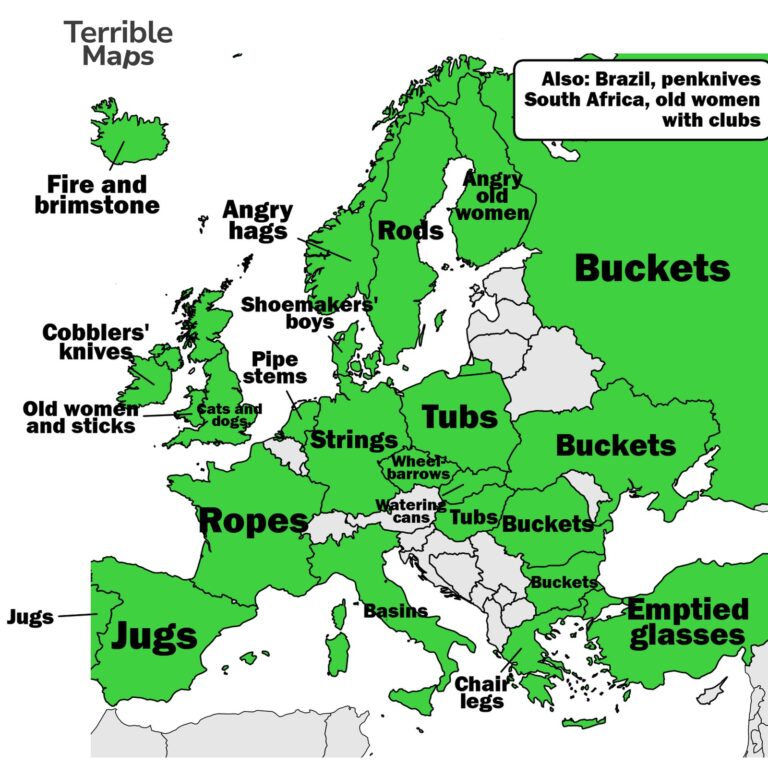
What it rains in each country instead of cats and dogs
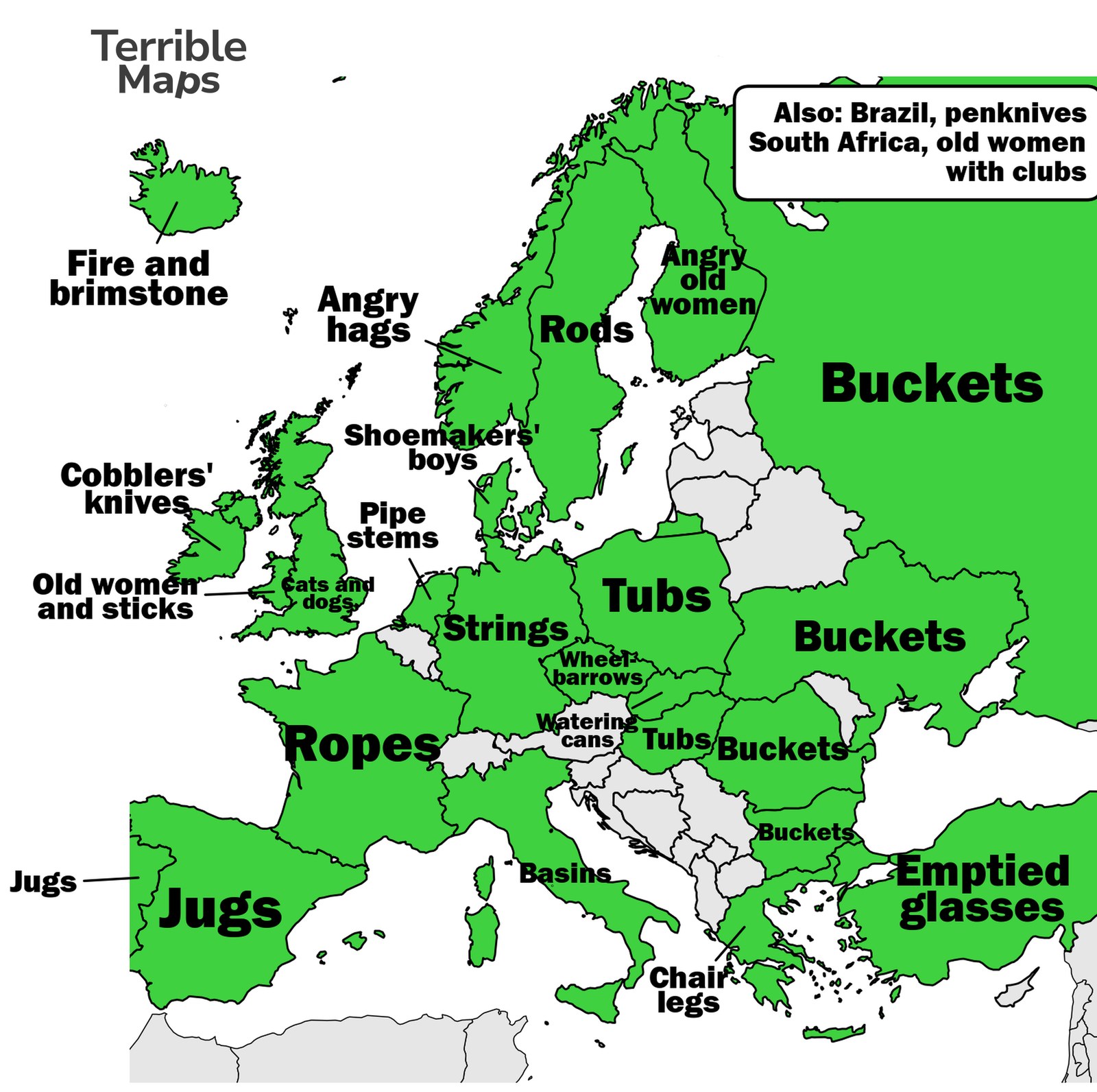
Nobody knows where raining cats and dogs comes from. In France it rains ropes, in Spain jugs, in the Netherlands pipe stems and in Norway angry hags.
This map has its own post: What it rains instead of cats and dogs.
Sources: Wikipedia, Raining cats and dogs, Wiktionary, pleuvoir des cordes, llover a cántaros, rain cats and dogs.
What each country says instead of 'when pigs fly'
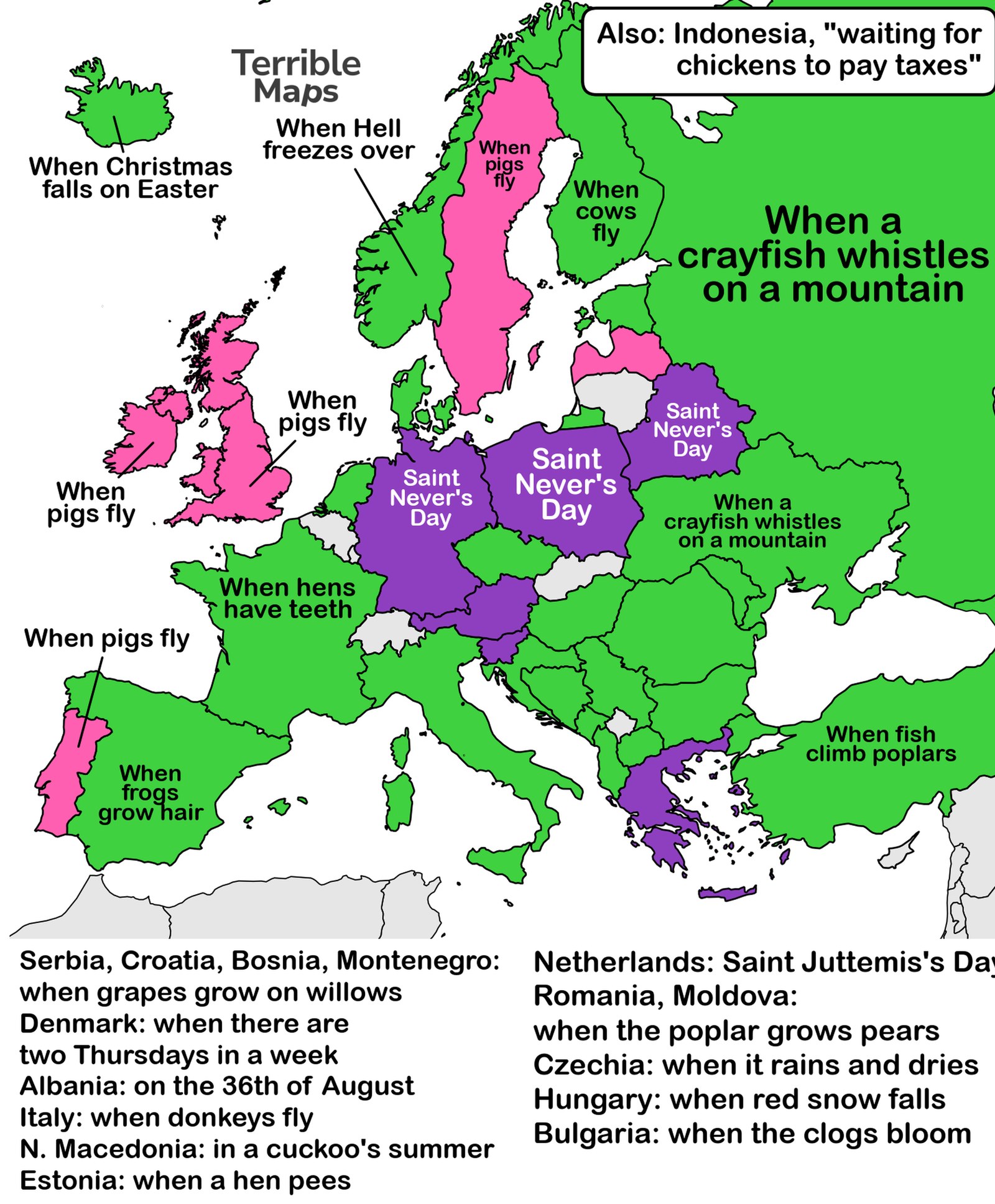
Russians wait for a crayfish to whistle on a mountain, Danes for a week with two Thursdays in it, and Albanians for the 36th of August.
This map has its own post: What each country says instead of 'when pigs fly'.
Source: Wikipedia, List of idioms of improbability.
What you sleep like in each country
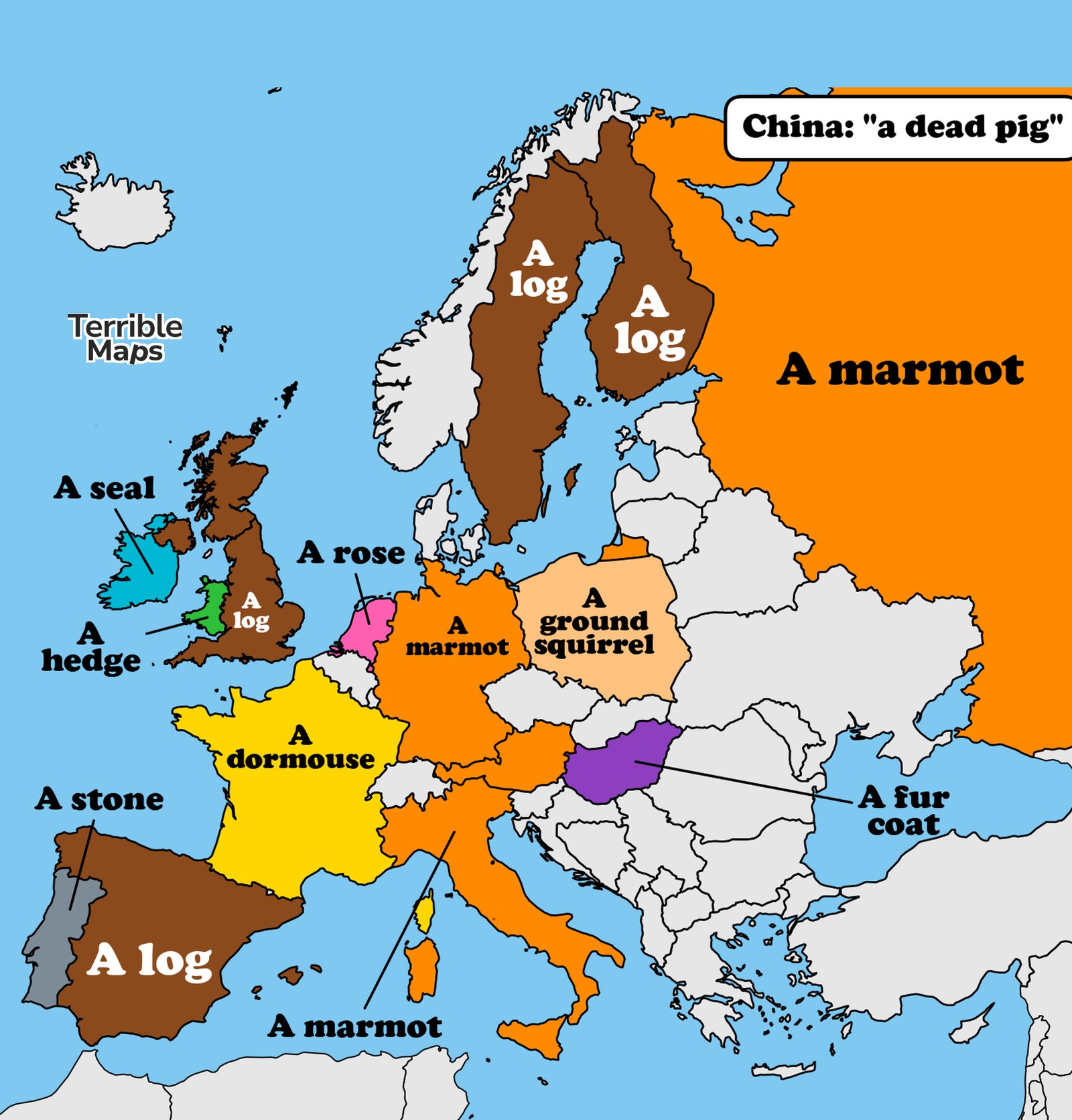
The English sleep like a log, and so do the Swedes, Finns and Spanish. Germans and Italians sleep like a marmot, and in Mandarin you sleep like a dead pig.
This map has its own post: What you sleep like in each country.
Source: Wiktionary, sleep like a log (translations).
What countries call leaving a party without saying goodbye
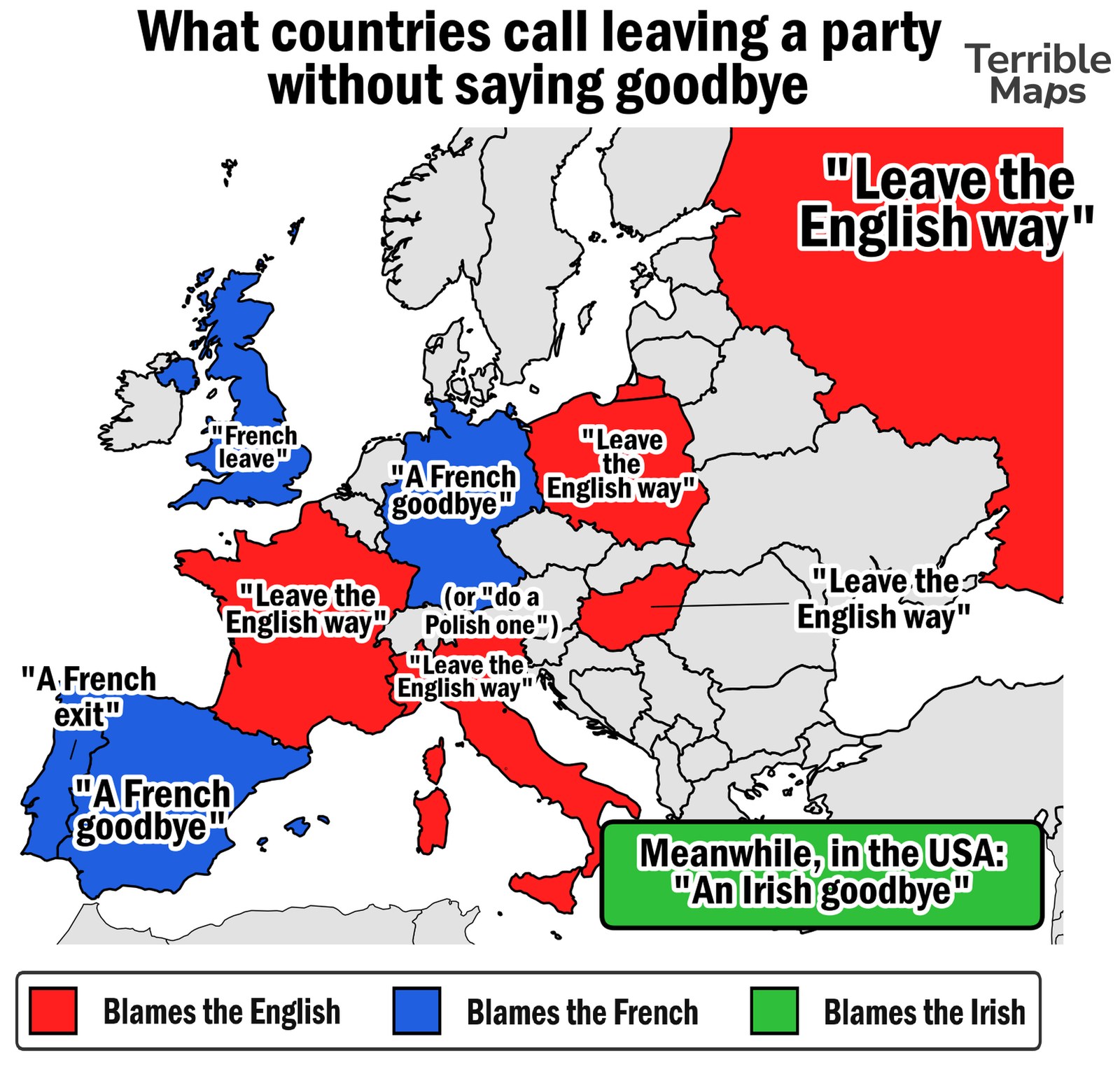
English speakers call it French leave, first recorded in 1751, and the French call it filer à l’anglaise, leaving English style. Italians and Poles blame the English too, while Americans call it an Irish goodbye.
This map has its own post: What countries call leaving a party without saying goodbye.
Source: Wikipedia, French leave.
It's all Greek to me: who each language says it can't understand
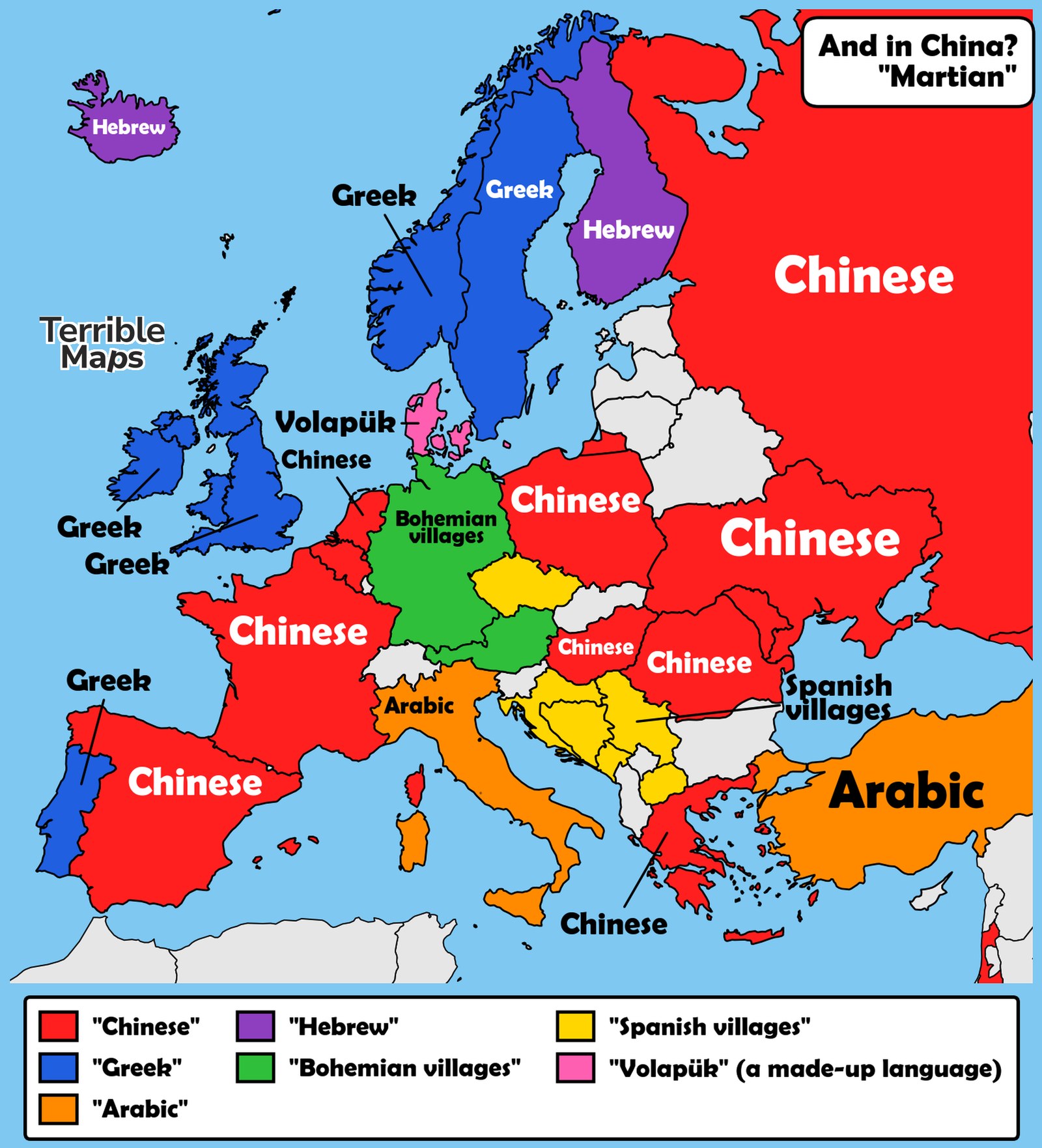
The English version is Shakespeare’s, from Julius Caesar. Germans say it’s Bohemian villages to them, Czechs say Spanish villages, Danes say pure Volapük, a language invented in 1879, and in Mandarin it’s Martian.
This map has its own post: It’s all Greek to me: who each language says it can’t understand.
Sources: Wiktionary, it’s all Greek to me, Wikipedia, Volapük.
What colour a black eye is in each country
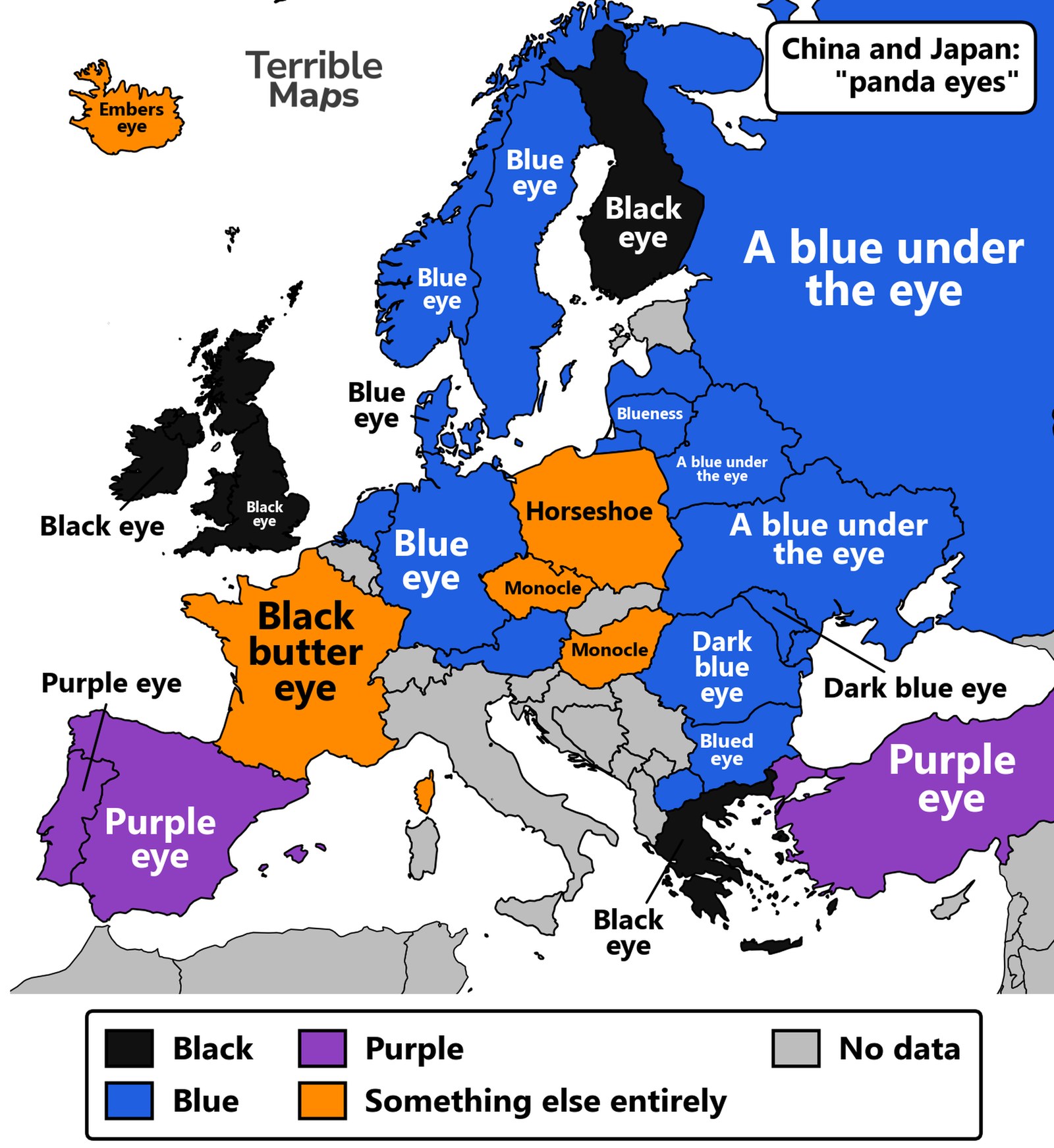
The French have had a black butter eye since at least 1585, Icelanders get an embers eye, and Spanish and Portuguese speakers get a purple one.
This map has its own post: What colour a black eye is in each country.
Sources: Expressio, un oeil au beurre noir, Wiktionary, black eye.
What Germany's neighbours call Germany
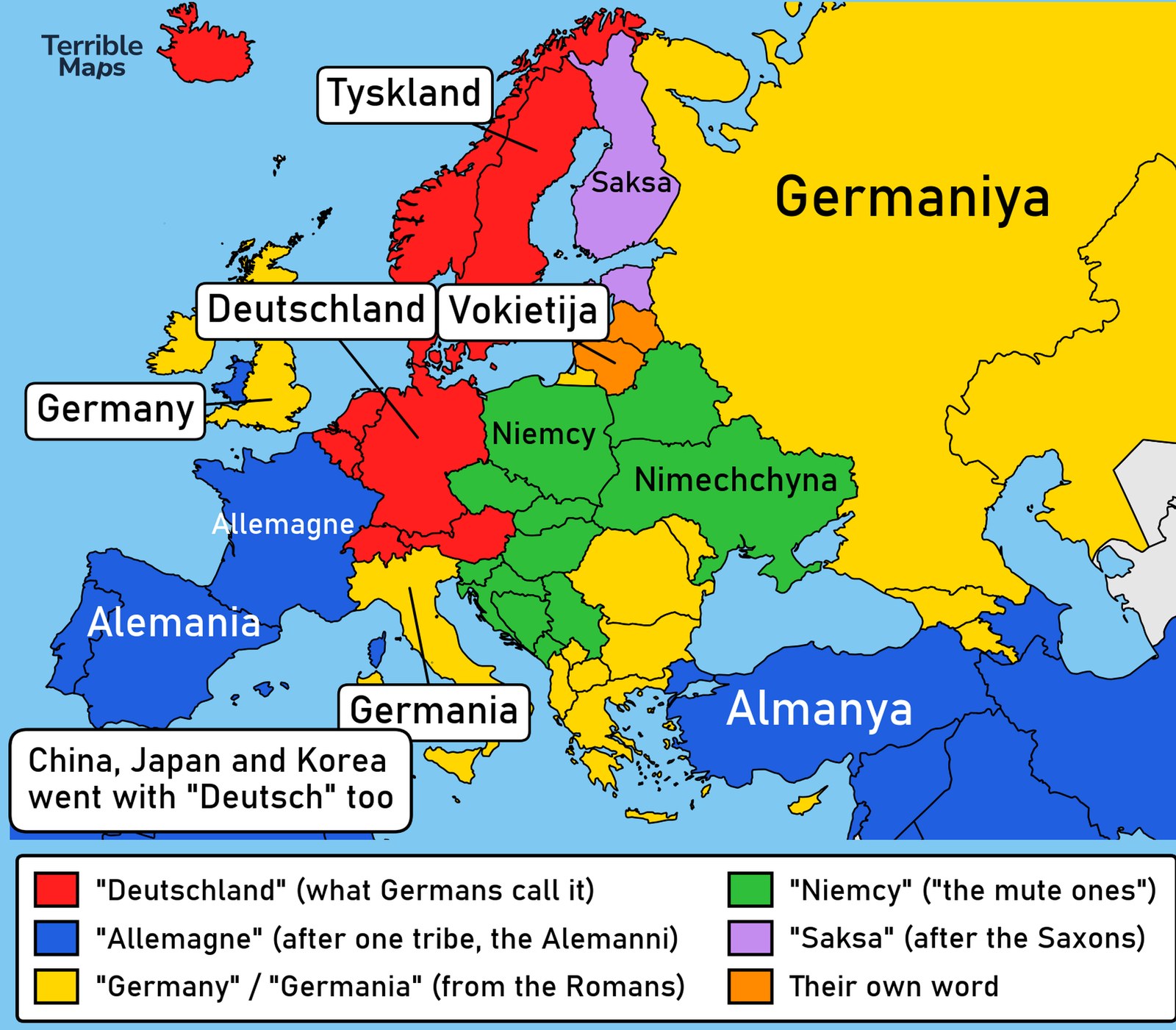
Germany calls itself Deutschland, from an old word meaning of the people. France and Spain named it after the Alemanni tribe, Finland after the Saxons, and the Polish Niemcy comes from a word for speechless.
This map has its own post: What Germany’s neighbours call Germany.
Source: Wikipedia, Names of Germany.
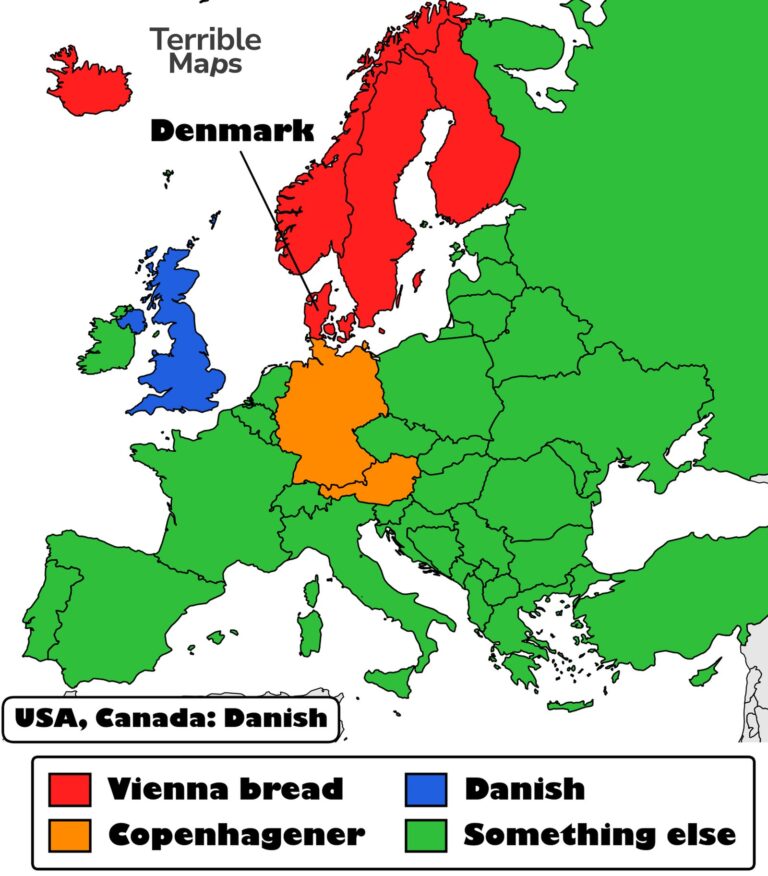
What Danish pastries are called in Denmark
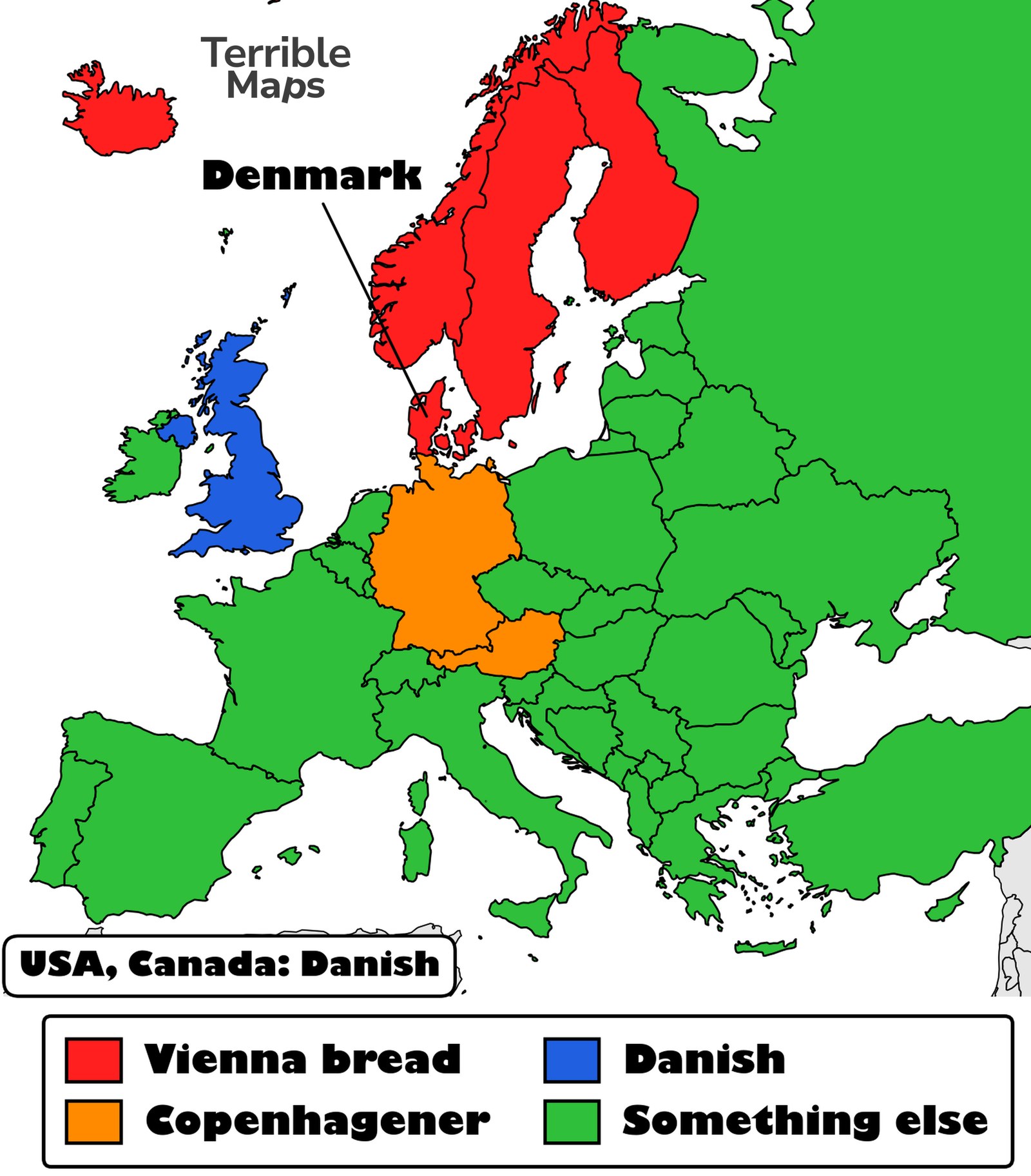
In Denmark, Norway and Sweden it’s wienerbrød, Vienna bread. The usual story is that Danish bakeries hired Austrian bakers during a strike in 1850. In Austria it’s a Kopenhagener.
This map has its own post: What Danish pastries are called in Denmark.
Source: Wikipedia, Danish pastry.
What Europe calls French toast
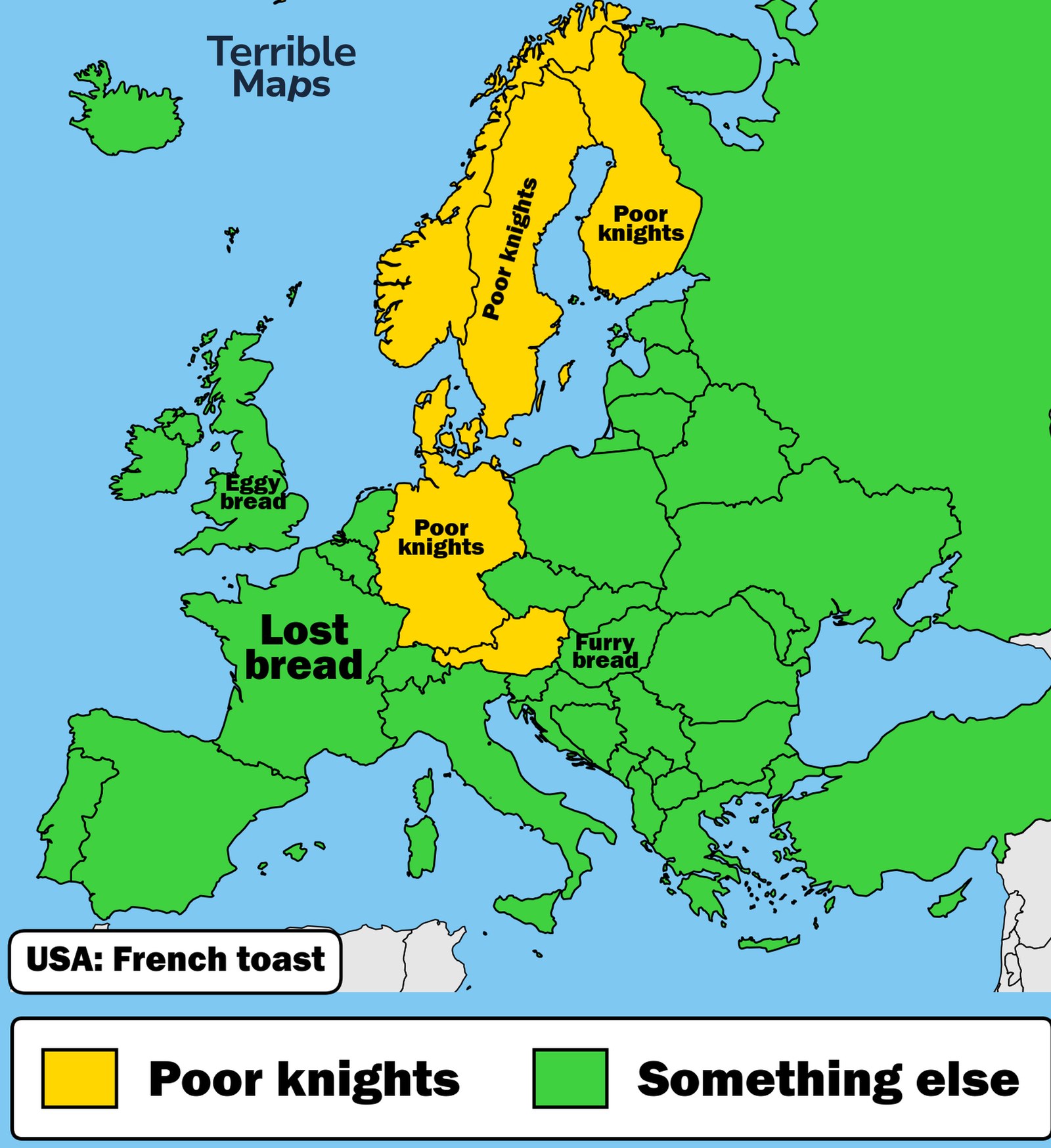
In France it’s pain perdu, lost bread, because it uses up stale bread. Germans, Danes and Finns call it poor knights, and in Britain it’s eggy bread.
This map has its own post: What Europe calls French toast.
Source: Wikipedia, French toast.
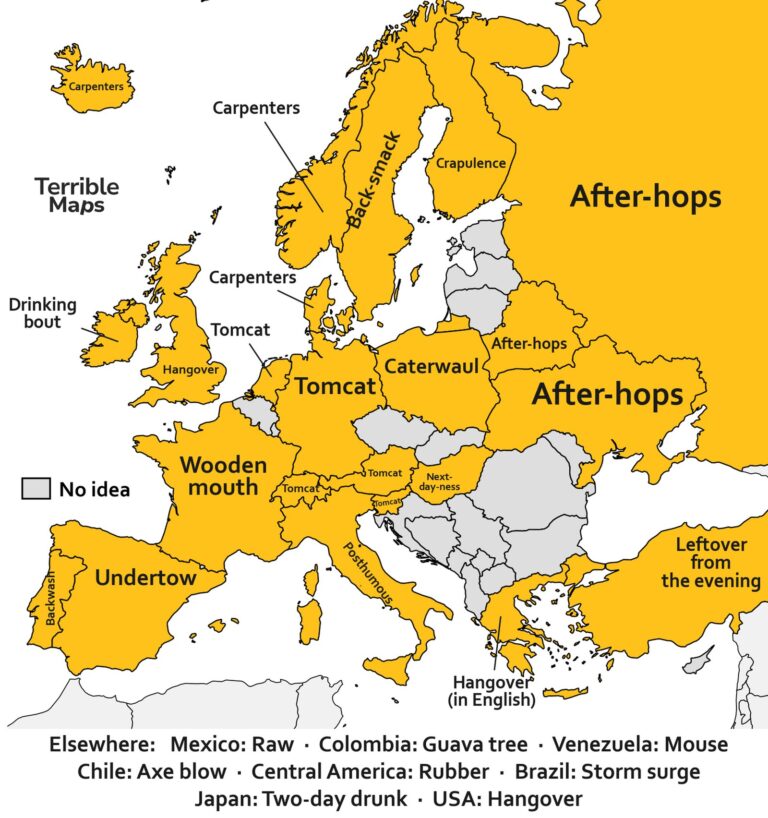
What a hangover is called in each country, translated literally
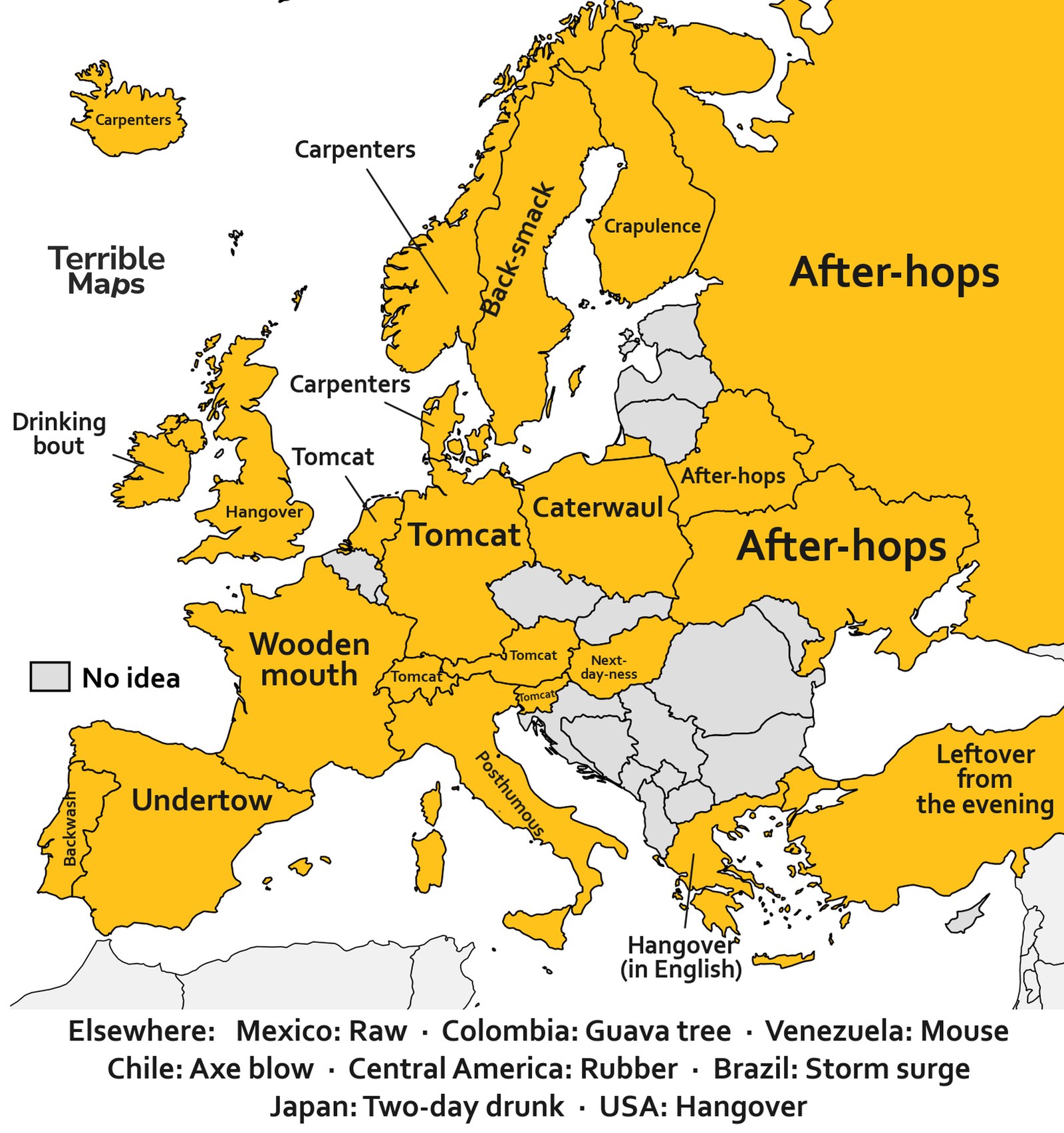
In Germany, the Netherlands and Slovenia a hangover is a tomcat. Denmark, Norway and Iceland call it carpenters, after the small men hammering inside your head. The French wake up with a wooden mouth. Hungary has next-day-ness. Aristotle wrote that a hangover hurts more than being drunk, and the Greeks now use the English word.
This map has its own post: What a hangover is called, translated literally.
Sources: Wiktionary, Kater, kater, tømmermænd, timburmenn, gueule de bois, másnapos, SSKJ, maček, NAOB, tømmermann, The Local Denmark, Sententiae Antiquae, kraipale, Greek Wiktionary, hangover.
What each country calls splitting the bill, translated literally
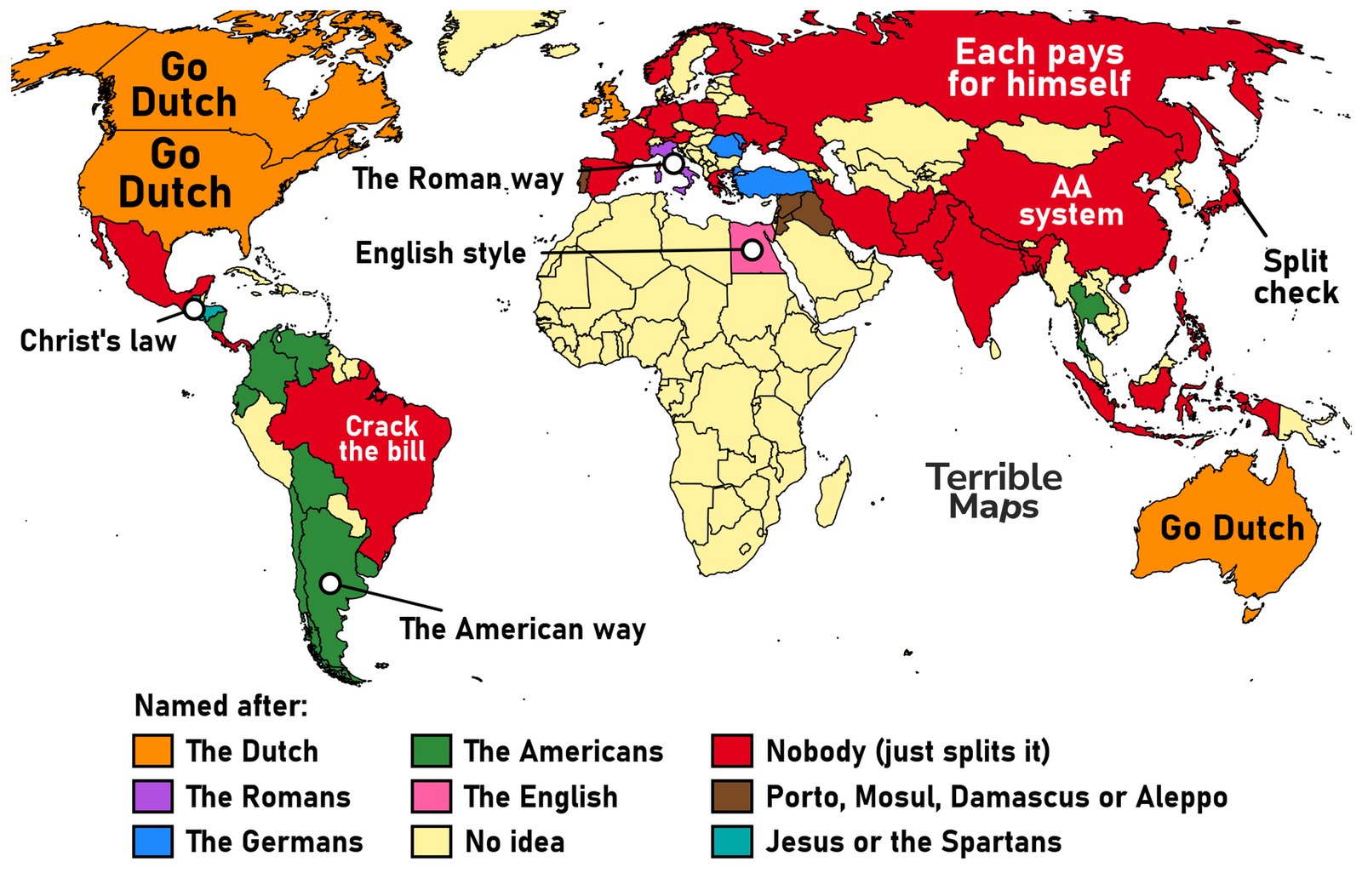
English speakers go Dutch. Italians pay the Roman way, which means splitting the total evenly. Turkey uses the German method, and Thailand calls it American share. Several Latin American countries pay the American way, which in America itself is called going Dutch.
This map has its own post: What each country calls splitting the bill, translated literally.
Sources: Wikipedia, Going Dutch, Wordorigins, Dutch treat, Wiktionary, alla romana, Diccionario de americanismos, americana, Tasty Thailand.
What Europe calls a potato, translated literally
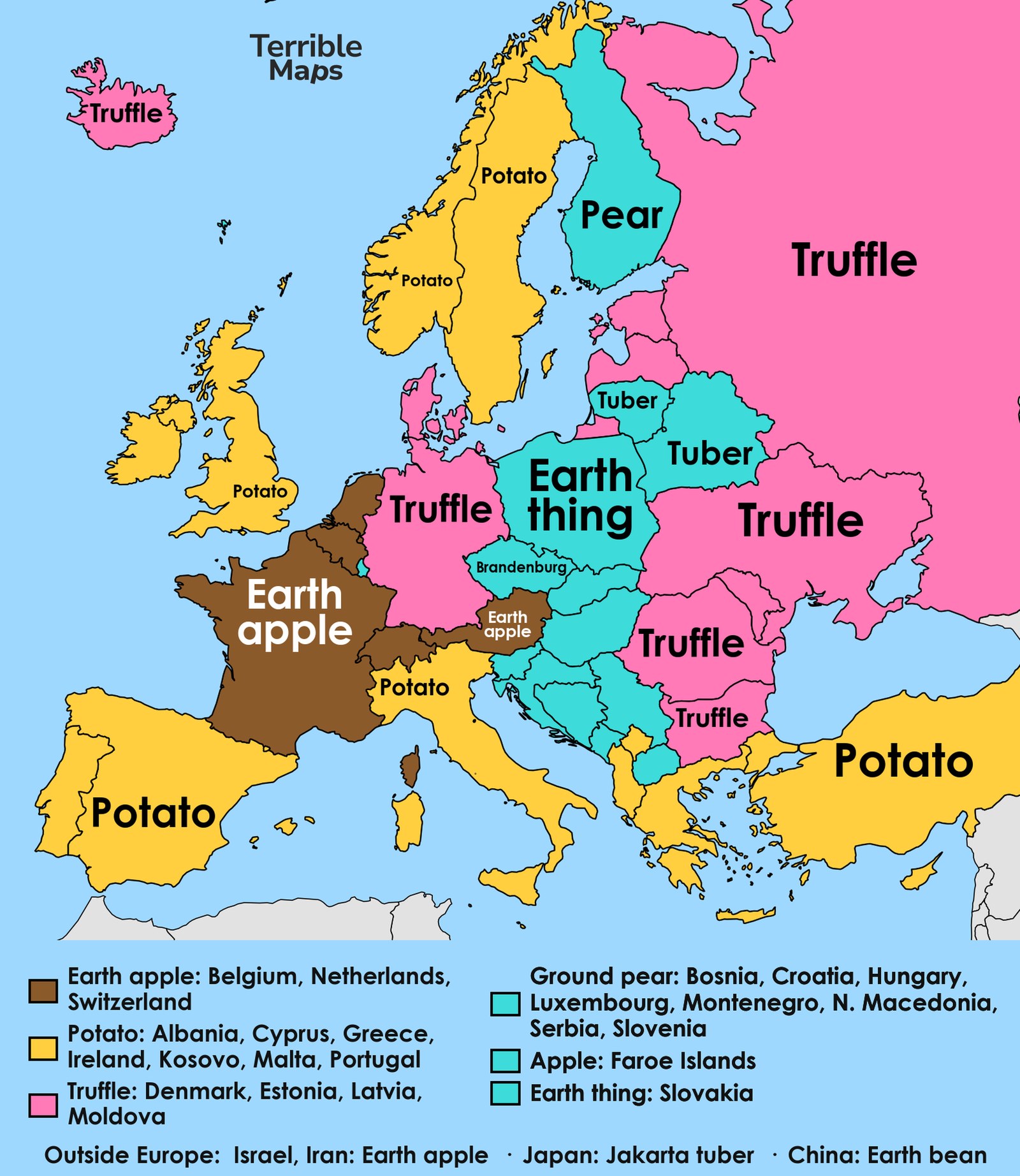
The French call a potato an earth apple. Hungary’s krumpli comes from Grundbirne, an old German word for a ground pear. The German Kartoffel comes from the Italian for a little truffle. The Czech word brambor is said to be named after Brandenburg, because Prussian soldiers brought potatoes into Bohemia, during a war that was nicknamed the Potato War.
This map has its own post: What Europe calls a potato, translated literally.
Sources: Wiktionary, pomme de terre, krumpli, Grundbirne, Kartoffel, brambor, Wikipedia, War of the Bavarian Succession.
Europe, translated literally from Chinese
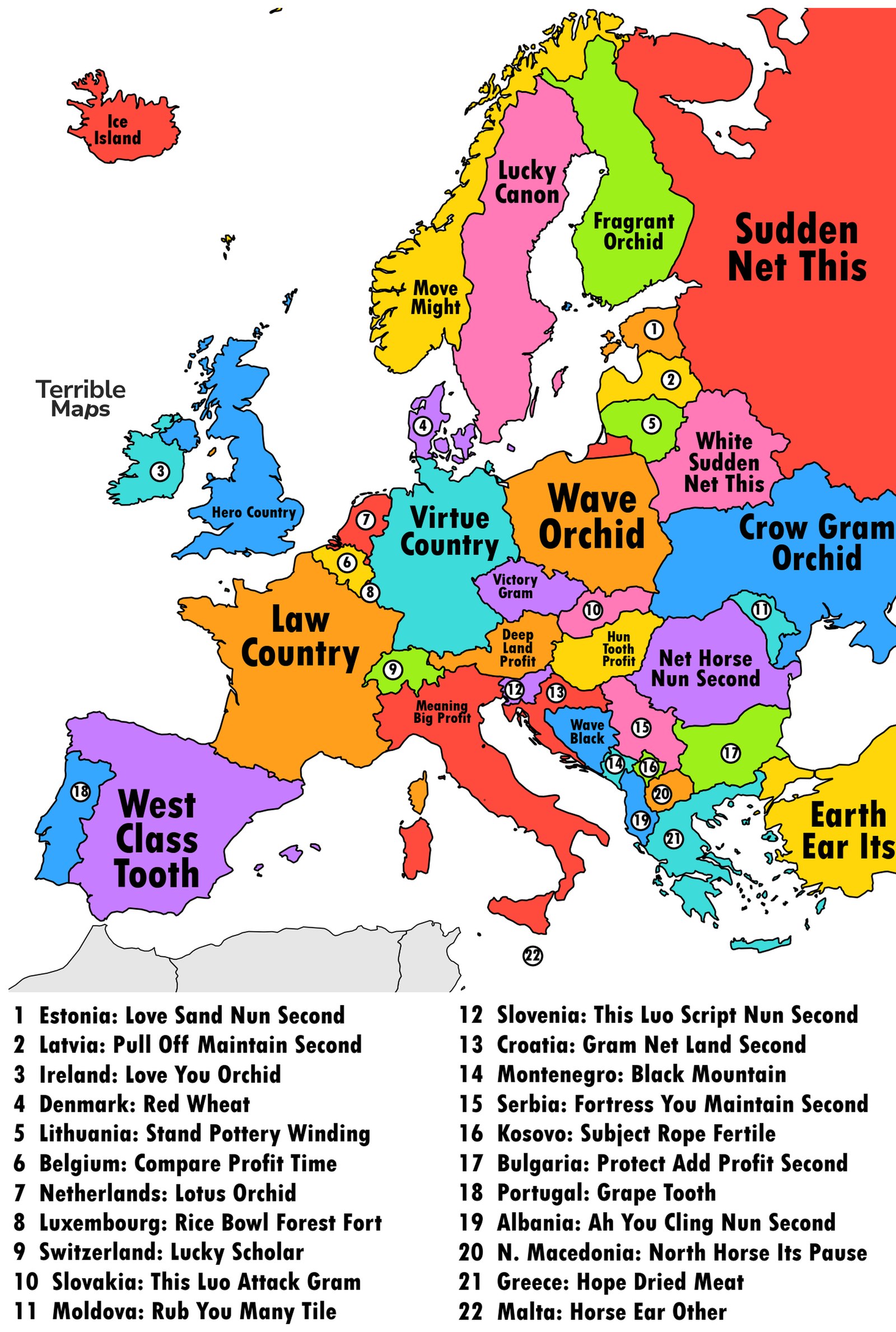
Chinese writes most foreign names with characters chosen for their sound, so reading them for their meaning gives you a different Europe. Russia becomes Sudden Net This, and Portugal is Grape Tooth. Montenegro is one of the few names that really is translated, as Black Mountain. Greece is Hope Dried Meat.
This map has its own post: Europe, translated literally from Chinese.
Sources: Wiktionary, 俄, 希, 臘, Chinese Wikipedia, 黑山, Wikipedia, Transcription into Chinese characters.
Europe, spelled by ear
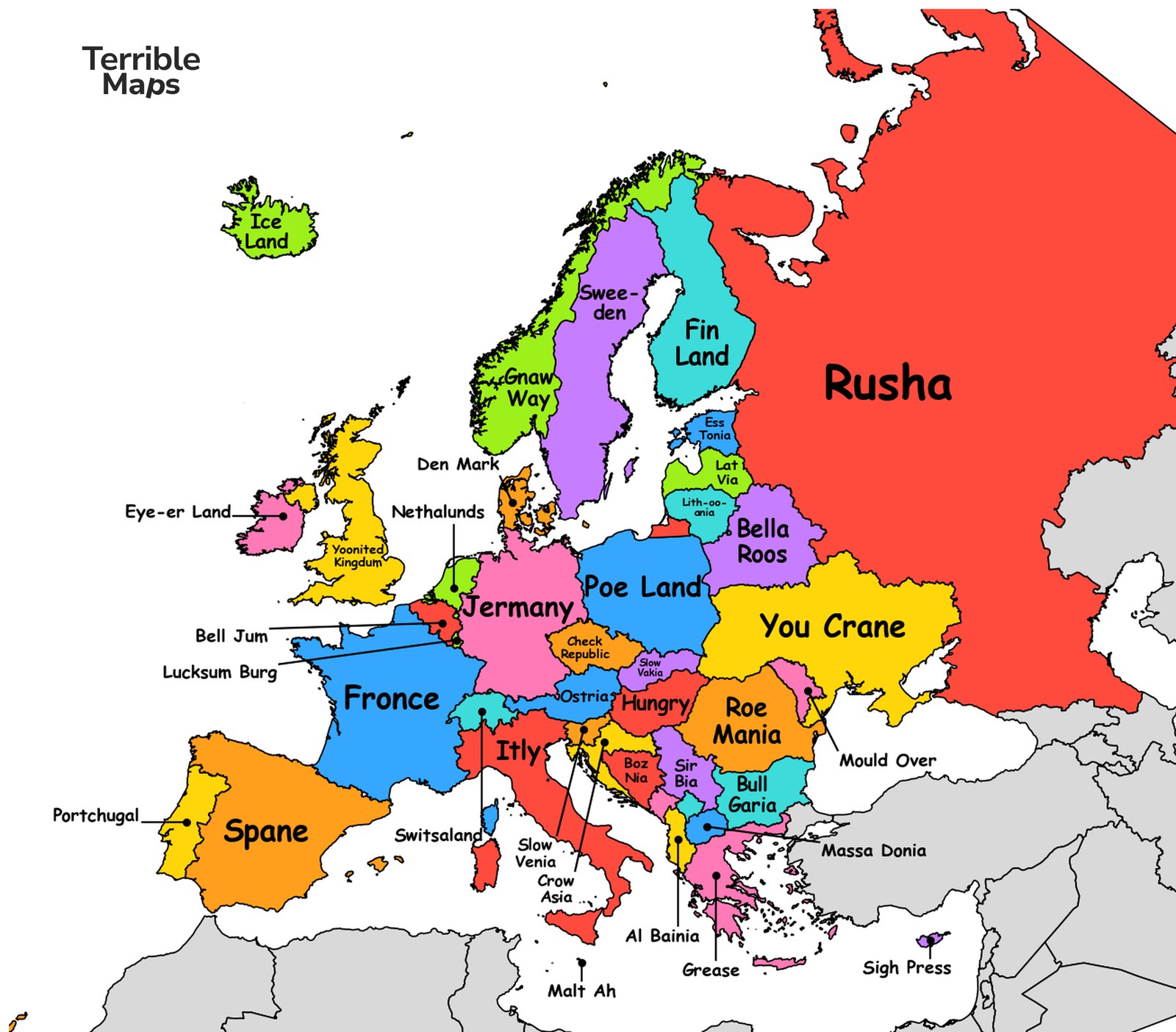
Every country in Europe, spelled the way it sounds. Germany is Jermany, Spain is Spane, and Ukraine is You Crane. Ireland is Eye-er Land, and the Czech Republic is the Check Republic. Hungary comes out as Hungry, Greece as Grease and Moldova as Mould Over.
Share these maps
More from Terrible Maps
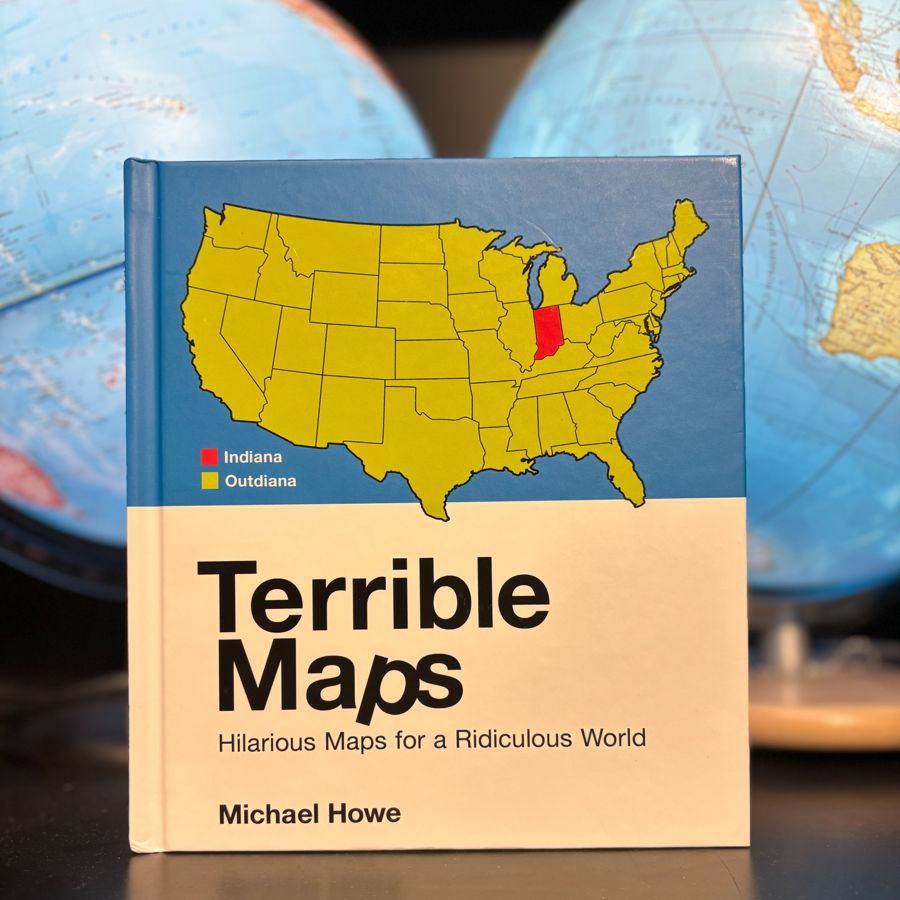 The bookTerrible Maps: Hilarious Maps for a Ridiculous WorldOut now in the UK, US, Canada and Australia.
 The shopShirts, hoodies, mugs and printsIncluding the Africa / Asia T-shirt.
There’s a new terrible map most days on Facebook and Instagram.